

Anyone who has carried a sofa up a Philadelphia rowhome staircase knows that the hard part of the day is rarely the driving. It is the turn at the top of the stairs. It is the doorway that measures thirty inches instead of thirty-six. It is the block where every parking space is taken by seven in the morning and the truck has nowhere to sit.
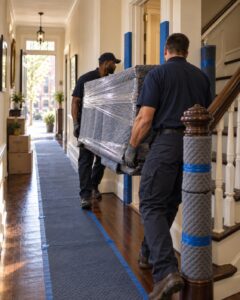
Floor runners, banister padding, and door jamb protectors go down before the first piece of furniture moves in a Philadelphia rowhome.
A Philadelphia rowhome move is its own category of work. The homes are beautiful, often historic, and almost never designed around the dimensions of modern furniture. At Litemovers, we plan these moves differently than we plan a move out of a suburban colonial in Wayne or a ranch house in Bucks County — and the planning starts well before the truck shows up.
Why Rowhomes Change the Math
Rowhomes across Fishtown, South Philadelphia, Queen Village, Northern Liberties, and West Philly share a set of features that shape move day:
- Narrow, often winding staircases with a landing or a hard turn partway up
- Tight front doorways, sometimes with a vestibule and a second interior door
- Front steps and stoops that reduce the working space between truck and door
- No driveway, meaning the truck lives on the street for the duration
- Shared walls and close neighbors, which limits how much you can stage outside
- Original floors, plaster, and railings that need protection, not just care
None of these are problems. They are constraints. The difference between a smooth day and a long one is whether those constraints were measured in advance or discovered at eight in the morning.
The Furniture That Causes Trouble
In our experience, a short list of items accounts for most rowhome delays: full-size sleeper sofas, sectional pieces that do not separate, king mattresses and box springs, armoires and tall dressers, treadmills, and large-format artwork or mirrors. Glass-front cabinets and antique case goods add a second layer, because they need both disassembly and protection.
If any of these are in your home, they should be measured and discussed during the estimate — not sized up in the stairwell.
Measure Three Things Before Move Day
You do not need a full survey. You need three numbers.
1. The Narrowest Doorway
Measure the actual clear opening with the door open, not the frame. On many older rowhomes, a door that will not swing fully back costs you two or three inches, which is often exactly the margin you need. Doors can usually be removed at the hinge and rehung the same day.
2. The Staircase Turn
Measure the width of the stair treads and the diagonal clearance at the turn or landing. A staircase that is comfortable to walk up can still be impossible for a rigid piece of furniture, because furniture does not bend at the waist.
3. The Curb
Walk the block at the time of day your move will happen. Note where the truck can realistically sit, how far that is from your front door, and whether any low branches, wires, or bus stops are in the way. Carry distance matters more than most people expect.
Parking Is a Permit Question, Not a Luck Question
This is the single most common avoidable problem in a Philadelphia rowhome move. The city has a formal process for it: a Temporary No Parking permit, applied for through the Streets Department, which lets you reserve curb space for a moving truck or container.
A few practical notes from doing this often:
- Apply well ahead of your date. The city asks for the application at least four business days in advance, and building in more time than that is wise during busy months.
- You will need the truck length, the address, and your start and end times, so confirm the truck size with your mover before you apply.
- Once the permit is issued, you pick up temporary no-parking signs from your police district and post them — ideally as soon as you have them, and at least 24 hours before the move.
- Posting the signs early is what actually clears the space. The permit alone does not move parked cars.
Current requirements and the online application are on the City of Philadelphia’s Temporary No Parking permit page. If you are moving out of the city limits — say, into Lower Merion, Ardmore, or Media — check with that municipality separately, since suburban rules differ and some towns require nothing at all.
Protecting the House You Are Leaving
Many rowhomes are being sold, and the condition you leave them in matters. Others are rentals with a deposit attached. Either way, protection is not optional in a narrow home, because every piece of furniture passes within inches of a wall.
On a rowhome job, our crews typically set:
- Floor runners on the full path from the door through the main hallway
- Banister and railing padding, especially on original wood
- Door jamb protectors at the front door and any pinch-point interior doorway
- Corner guards at stair landings and hallway turns
- Blankets and stretch wrap on upholstered and wood furniture before it leaves the room
Wrapping furniture in the room rather than at the truck is a small habit that prevents most wall scuffs. It costs a few extra minutes and saves a patch-and-paint conversation later.
When the New Place Is Not Ready
Rowhome sales and city closings shift. Settlement moves by a week. A renovation runs long. A tenant has not vacated. This happens often enough that it is worth deciding early how you would handle it.
Short-term storage is usually the cleaner answer than trying to compress a move into a single unpredictable day. Litemovers can hold household goods in warehouse vault storage between a move-out and a move-in, which is especially useful when you are leaving a rowhome on a fixed date but taking possession of the next home later. If you are renovating the new place first — refinishing floors, redoing a kitchen — storing furniture until the work is finished is almost always less expensive than moving it twice.
Planning the Day Itself
A few things consistently make rowhome days shorter:
- Empty the stairs and hallway completely the night before, including anything hanging on the walls of the stairwell.
- Pack the small stuff fully. Loose items in a narrow home slow a crew more than heavy items do. If packing feels like more than you want to take on, full or partial packing service is worth pricing out.
- Label by room in the new home, not the old one.
- Decide in advance what is not going. A rowhome basement or third-floor bedroom is a common place for things nobody actually intends to keep. Donation and disposal decisions are cheaper made before move day.
- Plan for people and pets. A crew working a narrow staircase needs the path clear.
If You Are Moving Out of State
A Philadelphia rowhome move that ends in Boston, Raleigh, or Charleston is a different regulatory animal than a move across Philadelphia. Interstate household goods moves are federally regulated, and you have specific rights around estimates, paperwork, and claims. Before you book any long-distance move, it is worth reading the FMCSA’s consumer guidance at Protect Your Move, which explains what a legitimate mover is required to give you and how to verify a company’s registration.
Ask any long-distance mover for its USDOT number, get the estimate in writing, and read the valuation coverage section rather than assuming your goods are insured at replacement value by default.
The Short Version
A Philadelphia rowhome move rewards preparation more than almost any other kind of move. Measure the doorway, measure the stair turn, get the parking permit posted early, protect the path, and decide ahead of time what happens if the dates slip. Do those five things and the day usually runs on schedule.
Litemovers handles local moves throughout Philadelphia, the Main Line, Montgomery County, Chester County, Delaware County, and Bucks County, as well as long-distance moves to East Coast destinations. We also help with packing and unpacking, senior moves and downsizing, furniture protection, and storage during renovations or delayed closings.
Planning a move in Philadelphia, the Main Line, or beyond? Contact Litemovers for a free quote and practical guidance before move day — including a walkthrough of the stairs, doorways, and parking situation at both ends.
© 2026 Litemovers. All rights reserved.

Comments are closed.