

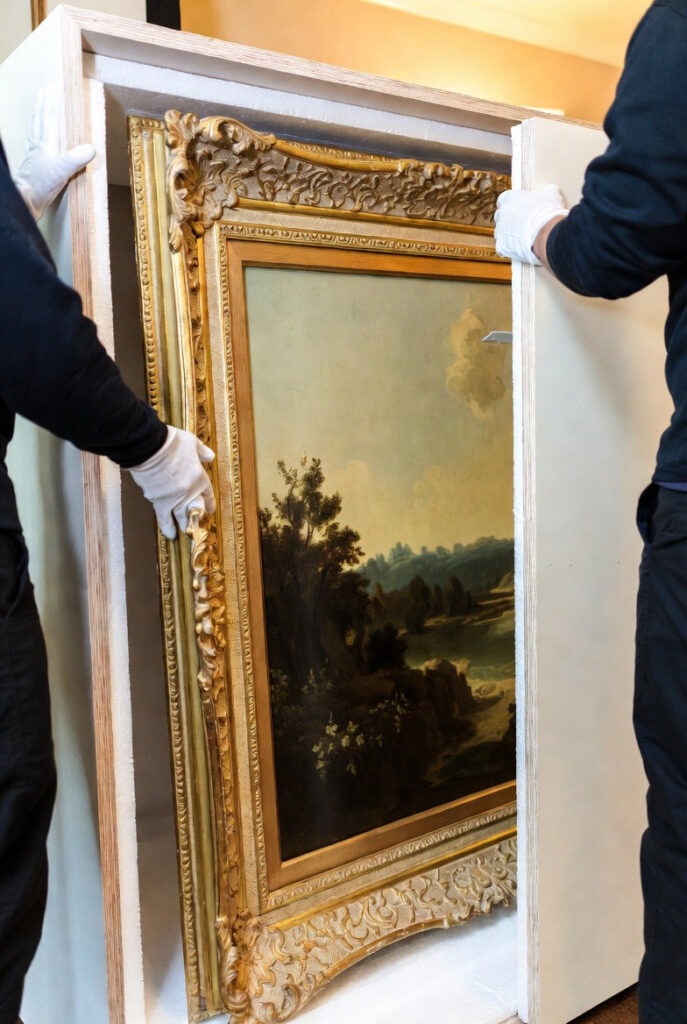
There are items in a Main Line home that money can replace. And there are items that money cannot — not really. A bronze sculpture acquired in Florence in 1987. A live-edge walnut dining table commissioned from an artisan who no longer takes orders. A framed oil painting that has hung in the family for three generations. A garden statue that arrived from the same Provençal estate sale as your mother’s dining chairs.
These things share a characteristic that determines how they must be moved: they are irreplaceable in any meaningful sense of the word. And they share a second characteristic that determines how they are too often moved: they do not fit neatly into the standard categories that most moving companies use to price and plan a job.
At LiteMovers, any item that meets one or more of the following conditions receives a purpose-built custom crate from MSS1.com (Precision Packaging & Crating) and is excluded from standard moving liability coverage if that crate is declined:
- Any statue or freestanding sculpture, regardless of material or size
- Any artwork — painting, print, photograph, textile, mixed media — valued at $3,000 or more
- Any live-edge, slab, or artisan-fabricated wood furniture piece valued at $3,000 or more
- Any garden or exterior sculpture, stone ornament, or architectural fragment
- Any three-dimensional decorative object with fragile protrusions, irregular geometry, or documented appraised value above $3,000
This guide explains why — in detail — for each category. It also explains what a custom crate does, what MSS1 builds, and what our policy means in practical terms on move day.
In this guide: The $3,000 threshold and why it exists • Statues and three-dimensional sculpture • Framed fine art and works on paper • Live edge and artisan wood furniture • Garden and exterior sculpture • What an MSS1 crate provides • Our no-crate, no-coverage policy • How to prepare for your estimate
The $3,000 Threshold: Why We Draw the Line There
Standard moving company liability is calculated at $0.60 per pound of item weight — the federal minimum for interstate moves, and the basis most carriers use for local moves unless you purchase additional valuation coverage. A framed oil painting weighing 12 lbs is covered for $7.20 under standard liability. A bronze sculpture weighing 40 lbs is covered for $24. A live-edge dining table weighing 180 lbs is covered for $108.
None of those numbers bear any relationship to the actual value or replacement cost of the items described. We set the $3,000 threshold not because damage below that value doesn’t matter, but because above it the gap between standard liability and actual loss becomes so large that moving without a crate represents an unreasonable financial risk to the client — and an unreasonable professional risk to us.
What “standard liability” actually covers
If we move a $12,000 bronze sculpture without a crate and it is damaged, our standard liability covers $24. The homeowner absorbs the remaining $11,976. Moving insurance policies — when clients have them — typically require evidence of professional packing to honor a claim. A moving blanket is not professional packing for a bronze sculpture.
A crate from MSS1 for the same sculpture costs $275–$550. The decision is not a difficult one.
For items below $3,000, we still encourage clients to discuss their belongings with us during the estimate. Many items below that threshold — a beloved garden urn, a commissioned ceramic piece, a family heirloom with sentimental but limited appraised value — warrant crating on care grounds even when the financial calculation is less clear-cut. We will always give you our honest assessment.
Statues and Three-Dimensional Sculpture
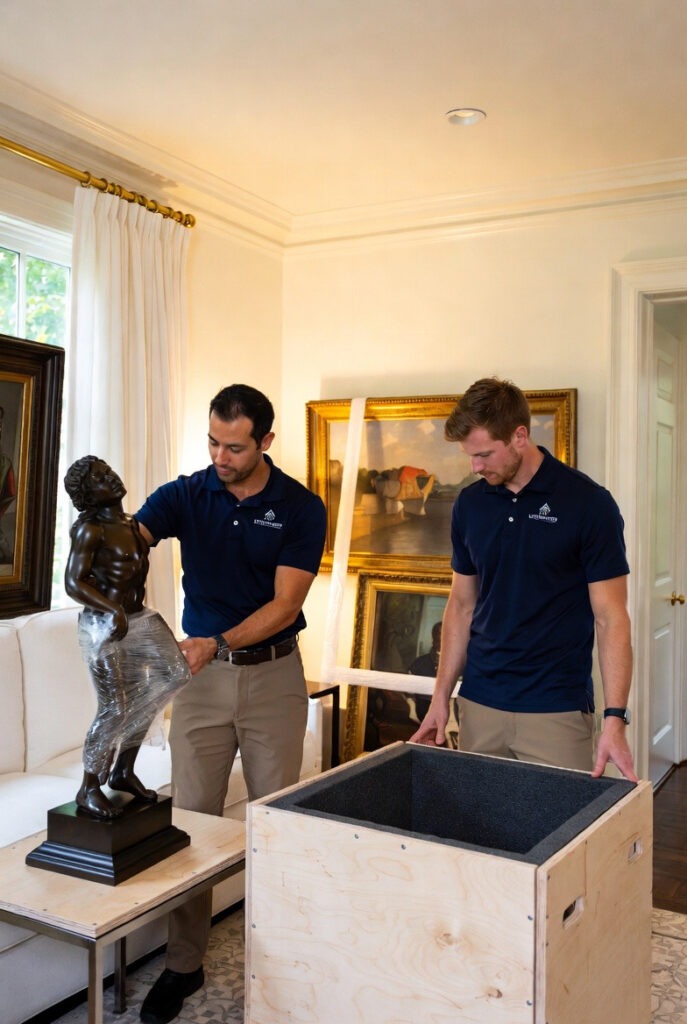
Three-dimensional sculpture presents a crating challenge that is categorically different from flat art or rectilinear furniture: the geometry is irregular, the weight distribution is often asymmetrical, and the most visually significant elements — extended limbs, thin necks, cantilevered forms, surface texture — are frequently the most structurally vulnerable.
Bronze and cast metal sculpture
Bronze is a heavy, durable material in compression. It is not durable under impact or leverage stress applied to thin projecting elements. A figurative bronze with an outstretched arm, a bird in flight, or an abstract form with cantilevered sections has clear failure points that a blanket wrap cannot protect. The bronze itself does not break easily, but:
- Thin projecting elements will shear if subjected to lateral impact or if the piece tips during transport and the projection contacts the crate wall or truck floor.
- Patina and surface finish are easily damaged by contact with moving materials. A blanket rubbing against a patinated bronze surface under vibration will lift and transfer the patina. This damage is permanent and restoration is expensive.
- Base and mount damage from vibration if the sculpture is not immobilized. A bronze rocking on a truck floor will destroy its own base and anything it contacts.
Stone, marble, and carved sculpture
Carved stone and marble sculpture combines the surface fragility of marble (discussed in our countertop guide) with the structural vulnerability of projecting three-dimensional form. A stone figure with extended hands, a carved floral arrangement, or a relief panel with deep undercutting has points of minimum cross-section that are orders of magnitude weaker than the body of the piece. These are the failure points in transit.
- Projecting elements fracture at their narrowest cross-section under any significant lateral load. A carved hand or flower stem on a marble piece may be only 1–2 inches in cross-section at its base — enough to support its own weight in a static installation, not enough to withstand transport forces without support.
- Base fracture from vertical shock if the piece is not cushioned from below. Stone sculpture on a hard truck floor with no base isolation will transmit every road shock directly through the base of the piece.
Ceramic and glass sculpture
Fired ceramic and glass sculpture, including large decorative vessels, are brittle throughout — there is no plastic deformation before failure, meaning the piece gives no warning before it breaks. A ceramic piece that survives 99 impacts will fail completely on the 100th. For glass sculpture, any contact with a hard surface during transport is a potential total-loss event.
How MSS1 crates three-dimensional sculpture
Unlike rectilinear items, sculpture cannot be described by a simple set of dimensions. MSS1 works from detailed measurements — and in many cases photographs — of the specific piece to engineer the crate interior. The foam support system is designed to cradle the piece at its structural strong points (the base, the main body mass) while providing standoff clearance around all projecting elements so that no protrusion is in contact with any crate surface. For very complex or fragile pieces, MSS1 uses custom-formed foam (cut to shape using a hot wire or CNC router) rather than standard sheet foam.
Framed Fine Art and Works Valued Over $3,000
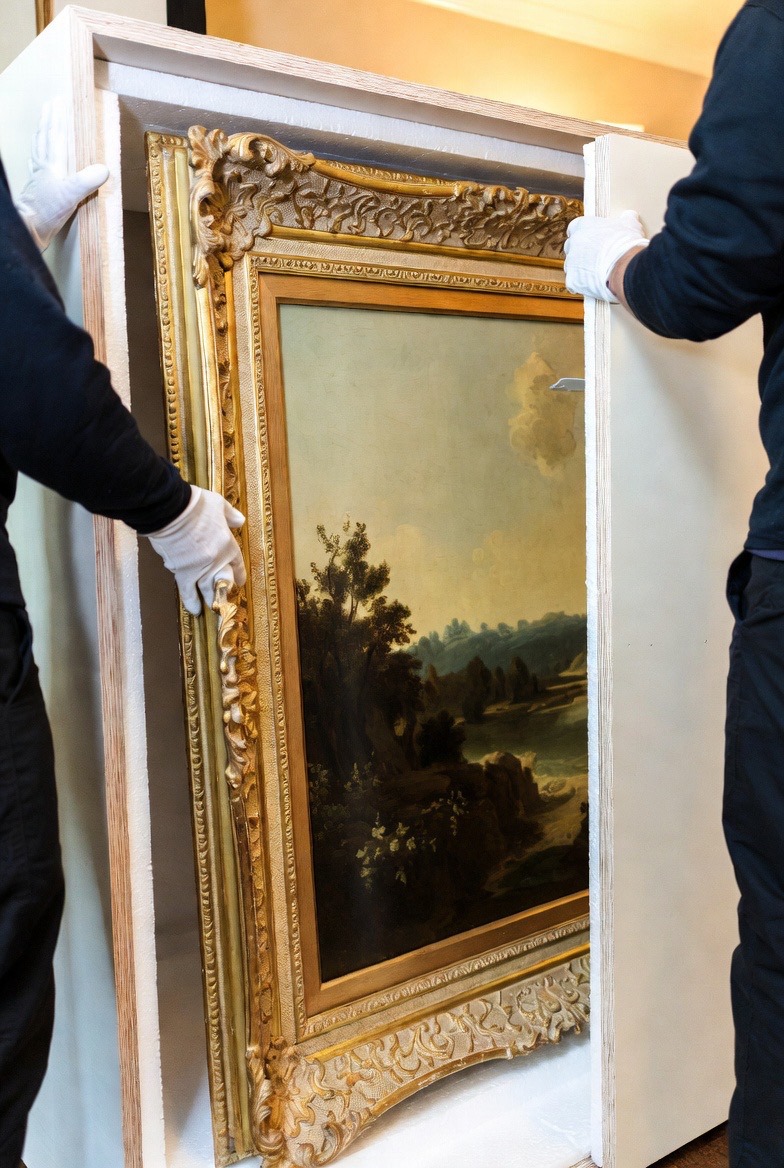
Framed paintings, large-format photographs, works on paper under glass, textile art, and mixed-media pieces valued above $3,000 require crating for reasons that differ by medium but converge on the same conclusion: a cardboard box with corner protectors is not adequate protection for a piece whose loss cannot be compensated by any filing with a moving company.
Oil paintings and works on canvas
A painted canvas has two principal vulnerabilities in transit: puncture and crush of the paint layer, and frame damage. The paint layer of an oil painting — particularly older works — is a thin, brittle film sitting on a flexible substrate. Any pressure on the face of the canvas will crack and flake the paint, and those losses are permanent. Restoration is possible but always visible under raking light, and it reduces the work’s value significantly.
- Frame corner and molding damage is the most common failure in standard art handling. Ornate gilt frames, carved wooden frames, and decorative moldings chip and break at corners and high-relief elements from any contact. The frame and the art are a single object — frame damage is art damage.
- Canvas puncture from any pointed object penetrating the packing material. A cardboard corner protector that collapses under load provides no puncture resistance.
- Surface abrasion from any material rubbing against the paint layer. Tissue paper, foam, and most packing materials will abrade a varnished oil surface if they contact it under vibration.
Works on paper, watercolor, and works under glass
Works on paper — drawings, watercolors, prints, photographs — are particularly vulnerable because the paper substrate itself is a damage point. Humidity changes during a move, contact with acidic packing materials, and compression from stacking can cause irreversible changes to paper works. For works under glass, any impact that cracks the glass creates a secondary hazard: glass fragments in contact with the work surface.
Oversized and panoramic art
Large-format art — anything over 40 inches in either dimension — requires a crate rather than a picture box because the unsupported span of the work creates flex risk across the face and frame. A 60×80 inch painting in a flat box will bow across its width during transport unless the face is supported against flex by the crate structure itself. MSS1 builds crates with internal cross-bracing for large-format works specifically to prevent this.
How MSS1 crates framed art
Art crates are face-out by default — the front face of the work is accessible and inspectable without opening the full crate. Foam standoff distance is maintained from all frame elements so that no part of the frame contacts the crate wall. The crate back supports the canvas stretcher at the perimeter. For works under glass, a rigid backing panel is added behind the work before crating to prevent the glass from flex-cracking during transit. All crates use acid-free foam contact materials on any surface that may touch the work.
Live Edge, Slab, and Artisan Wood Furniture Over $3,000
Live-edge and slab-wood furniture occupies a different category from standard furniture precisely because of the qualities that make it valuable: natural edge profiles, book-matched grain patterns, figured wood, and hand-finished surfaces are specific to a single piece of material. A live-edge walnut dining table commissioned from an artisan represents not just the cost of the wood and labor, but the particular character of that slab — the curve of its edge, the distribution of its figure, the warmth of its specific finish.
These are the reasons the piece was purchased. They are also the reasons it cannot be adequately protected by standard furniture moving methods.
Live edge and natural edge damage modes
- Edge chip and fracture. The natural live edge of a slab — the uncut bark or sapwood boundary — is the most visually significant and the most structurally thin part of the piece. Any contact with a hard surface, a blanket edge, or a loading ramp corner will chip, split, or crush sections of the live edge. These losses are visible and cannot be invisibly repaired in most species.
- Surface finish damage. Hand-rubbed oil finishes, hard-wax oil, and lacquer finishes on figured wood are not equivalent to factory furniture coatings. Scratches in the finish of a figured walnut or maple slab reveal white wood beneath and require full refinishing to address — a process that typically costs $500–$1,500 for a dining table and may alter the surface character the owner valued.
- Warp from improper orientation. A live-edge slab stored or transported flat without full face support can take on a permanent bow from its own weight across an unsupported span. This is particularly true for slabs in warmer temperatures where the wood remains slightly plastic.
- Slab fracture at thin sections. Highly figured and crotch-cut slabs often have irregular thickness — areas where the slab is thin due to the natural geometry of the tree. These thin sections are fracture points under lateral load.
Artisan and studio furniture
Studio furniture — pieces commissioned from individual makers, limited-edition design pieces, and one-of-a-kind fabrications — share the irreplaceability problem of fine art. The maker may no longer be producing that form, the material may no longer be available, and the piece itself has a provenance and identity that a replacement cannot carry. We treat studio furniture over $3,000 with the same protocol as sculpture: assess the specific vulnerabilities, design the crate to the piece, and build accordingly.
How MSS1 crates live edge and slab furniture
Slab furniture crates are designed around the same principle as countertop crates: the piece travels on edge (vertically), supported at the base, with closed-cell foam across both faces. The natural edge profile is given additional clearance — the foam does not attempt to conform to the live edge but instead maintains a standoff distance so the edge is suspended in clear space within the crate. For very large slab tables (96 inches or over), an A-frame internal structure prevents any mid-span loading on the face of the slab.
Garden and Exterior Sculpture
Garden and exterior sculpture is consistently the most under-protected category of high-value items we encounter during Main Line estimates. Homeowners who would never consider moving a bronze interior sculpture without a crate often assume that a stone garden figure, a cast iron urn, or a carved limestone finial is “already outdoor quality” and therefore transport-hardy. This conflates weather resistance with structural resilience during transport, and they are not the same thing.
A carved limestone garden figure that has stood in a Villanova garden for forty years is weather-resistant. It is not resistant to being loaded onto a truck without immobilization and driven over a pothole at 40 miles per hour. The transport forces are categorically different from the forces it was designed to resist.
Stone and carved garden ornaments
- Thin projections and decorative elements on urns, figures, and ornamental pieces are as vulnerable as any interior stone sculpture to fracture under lateral force. Finials, handles, carved garlands, and relief detailing are all failure points during transport.
- Frost weathering micro-fractures. Exterior stone that has been through multiple freeze-thaw cycles will often have developed micro-fractures through its cross-section that are invisible until a transport stress causes them to propagate. A piece that appears intact before a move may reveal fractures only when the load of transport is applied.
- Base instability. Garden sculpture is often unsecured at its base — it stands by weight. Without securing the piece inside a crate, any deceleration will tip it.
Cast iron and metal garden pieces
Cast iron urns, benches, and figures are dense and heavy, which creates a different risk: their weight becomes a liability if they shift during transport. A 200 lb cast iron urn that tips in a moving truck will destroy anything it contacts and may damage itself significantly at whatever surface it strikes. Cast iron is also brittle — it does not bend before it fractures, meaning a fall or impact produces a clean break rather than a dent.
Terracotta and fired clay
Large terracotta pots, planters, and ornamental pieces that have been in situ for years are often in a more fragile state than they appear. Hairline cracks from thermal cycling, root intrusion, and freeze-thaw stress are common and not always visible on the surface. These pieces require individual crating with foam that supports the full body of the piece, not just its base.
How MSS1 crates garden sculpture
Garden pieces often require cleaning and drying before crating — soil, moss, and moisture retained in stone are problems during crated storage and transport. We will advise clients on this during the estimate. The crate itself is built to the specific piece, with the base fully supported and the body immobilized by foam at its structural midpoints. For very heavy pieces, the crate includes forklift or pallet jack access points at the base for safe movement without manual lifting.
What MSS1.com Builds and Why We Use Them
MSS1.com (Precision Packaging & Crating) is our partner for all custom crate fabrication requiring engineered solutions beyond standard box construction. MSS1 has specific experience in high-value, irregular, and fragile item crating — exactly the category of work that art, sculpture, live edge furniture, and garden pieces require.
What distinguishes an MSS1 crate from a standard moving crate or picture box:
- Item-specific engineering. The crate dimensions and interior support system are designed for the specific piece being moved, not adapted from a standard size. MSS1 works from dimensions, photographs, and in some cases direct inspection of the item to engineer the interior.
- Ethafoam and closed-cell foam interiors. MSS1 specifies closed-cell polyethylene foam (Ethafoam or equivalent) for all interior contact surfaces. Closed-cell foam maintains its compression resistance throughout a move and does not absorb moisture. For pieces where any surface contact is unacceptable, MSS1 uses foam standoff systems that keep the piece suspended in clear space.
- CNC and hot-wire foam cutting for complex geometries. For sculpture with irregular forms, custom-formed foam is cut to the exact profile of the piece using CNC-routed or hot-wire techniques. The piece sits in a foam negative that matches its shape, eliminating any movement within the crate.
- ISPM 15 compliant wood for international moves. If your move involves international shipping, MSS1 crates meet international phytosanitary standards for wood packaging materials — a requirement for customs clearance in most countries.
- Reusable construction. All MSS1 crates are built to be opened and re-used. Latch hardware rather than fastened panels means the crate can be used again for your next move, for art fair transport, or for storage rotation.
Lead time for art and sculpture crates from MSS1 is typically 3–7 business days depending on complexity. We coordinate directly with MSS1 on your behalf once your estimate is confirmed. Please factor this into your move timeline.
Our Policy: No Crate, No Coverage
LiteMovers policy on art, sculpture, live edge furniture, and high-value items:
Any statue, sculpture, artwork, live-edge or artisan furniture piece, or three-dimensional decorative object valued at $3,000 or more will be moved only in a purpose-built custom crate from MSS1.com.
We do not move these items using moving blankets alone, cardboard boxes, standard picture boxes, foam wrap without a rigid outer structure, or any improvised method.
If crating is declined, the item is removed from the move agreement. We carry zero liability for any high-value item moved by any method other than a purpose-built MSS1 crate. This policy has no exceptions.
We state this policy at the estimate stage. Every high-value item is listed individually on your estimate with its crating cost shown as a separate line item. There are no surprises on move day, and there are no conversations on the truck about whether something needs a crate. Those conversations happen at the estimate, where they belong.
Why we are unwilling to negotiate on this
A damage claim on a $15,000 sculpture or a $25,000 painting does not end with a check. It ends with an irreplaceable object that is either destroyed or diminished — and with a relationship between a client and a moving company that cannot be repaired by any payment. We are not willing to be in that situation. A crate prevents it.
Typical Crating Costs for Art, Sculpture, and High-Value Pieces
MSS1 crate pricing is based on item dimensions, weight, material complexity, and whether custom-formed foam is required. The following ranges reflect typical pieces we encounter in Main Line moves:
| Item Type / Size | Typical Crating Investment |
|---|---|
| Small sculpture or decorative object (under 18″ in any dimension) | $150 – $275 |
| Medium sculpture or bronze figure (18″–36″) | $250 – $450 |
| Large sculpture or garden figure (36″–60″) | $400 – $700 |
| Framed painting or art up to 30×40″ | $175 – $300 |
| Framed painting or art 30×40″ to 60×80″ | $275 – $500 |
| Oversized or panoramic art (over 60″ in either dimension) | $450 – $800+ |
| Live edge dining table or large slab piece | $350 – $650 |
| Garden urn or large terracotta planter | $200 – $400 |
| Large garden figure or architectural fragment | $375 – $700+ |
| Complex or custom-foam sculpture (any size) | $500 – $1,200+ |
For context: art insurance premiums for a $15,000 painting run approximately $150–$300 per year. A crate to move that same painting costs $275–$500 once — and the crate can be retained for future moves and storage. A crate is the cheapest form of protection you will ever purchase for a piece of that value.
Crates can be stored with the piece.
If your new home is not ready for the art or sculpture to be installed — because of ongoing renovations, construction, or a timing gap — we can store crated pieces in our climate-appropriate storage facility and deliver when you are ready. The crate provides protection throughout the storage period as well as the move. Learn more about our storage solutions.
Preparing for Your Estimate: What We Need to Know
When you schedule your estimate, let us know you have art, sculpture, live edge furniture, or garden pieces to move. Our estimator will walk every room and every outdoor space with you, identify all pieces meeting the crating threshold, note their dimensions and any special considerations, and build the MSS1 crating specifications into your estimate before presenting a final number.
It helps to have the following information available:
- A rough count of sculptures, art pieces, and high-value decorative objects in your home
- Approximate dimensions of the largest pieces (height and widest point)
- Any pieces with known fragile elements — thin protrusions, works under glass, known loose or repaired sections
- Any pieces with recent appraisals or insurance documentation — this helps MSS1 understand replacement value context for the crate specification
- Whether pieces are going directly to the new home or into storage first
- Any garden or exterior pieces that need to be included
- Any pieces that may require cleaning or preparation before crating (garden pieces, unvarnished works, surfaces with existing repairs)
If you have art or sculpture with existing insurance coverage through a fine art or homeowner’s policy, please check whether your policy requires professional packing documentation for move claims. Our process generates that documentation automatically as part of the estimate and crate-order workflow.
LiteMovers — white-glove moving for Greater Philadelphia’s Main Line and Chestnut Hill. Ardmore • Bryn Mawr • Wayne • Radnor • Villanova • Chestnut Hill • Philadelphia.