

Buying moving supplies is where most moves go sideways. People guess, run short in the last 48 hours, and end up cramming fragile items into whatever is left. Here are the real numbers our crews see on homes across the Main Line, Chester County, and Philadelphia.
A 2-bedroom home needs about 45–60 boxes and 4 rolls of packing tape. Add 2 markers, a 10 lb bundle of packing paper, and 1 roll of bubble wrap. Studios need roughly 20 boxes, 3-bedroom homes about 80, and 4-bedroom homes about 110.
How many moving boxes do I need?
Box count scales with how long you have lived somewhere, not just square footage. Take two homes of identical size. A family in a Wayne colonial for 18 years packs far more than a couple in a new Conshohocken townhome. Use the table as your starting point, then add 15 percent if you have been in the home over ten years.
| Home size | Small | Medium | Large | Dish packs | Wardrobe | Total |
|---|---|---|---|---|---|---|
| Studio / 1BR apartment | 8 | 8 | 3 | 1 | 1 | ~21 |
| 2-bedroom apartment | 15 | 15 | 6 | 2 | 3 | ~41 |
| 2-bedroom house | 20 | 20 | 10 | 4 | 4 | ~58 |
| 3-bedroom house | 28 | 28 | 14 | 5 | 6 | ~81 |
| 4-bedroom house | 38 | 38 | 20 | 6 | 8 | ~110 |
| 5+ bedroom house | 50 | 50 | 26 | 8 | 10 | ~144 |
Order 10 percent more boxes than your total. Unused flat boxes are returnable at most suppliers. Running out at 9pm the night before is not fixable.
What size moving boxes should I use?
Four sizes cover almost everything. The rule our crews use is simple: the heavier the contents, the smaller the box. A box should never exceed 50 pounds.
| Box type | Size | Best for | Do not use for |
|---|---|---|---|
| Small | 1.5 cu ft | Books, records, canned goods, tools, hardware | Anything bulky |
| Medium | 3.0 cu ft | Kitchen items, toys, small appliances, files | Books |
| Large | 4.5 cu ft | Bedding, pillows, lampshades, winter coats | Anything dense |
| Extra large | 6.0 cu ft | Comforters, cushions, large light items | Almost everything else |
| Dish pack | 5.2 cu ft, double wall | Plates, glassware, stemware, ceramics | General storage |
| Wardrobe | With hanging bar | Hanging clothes, drapes, coats | Folded clothing |
| Mirror / picture | Adjustable, flat | Framed art, mirrors, glass tops | Flat-screen TVs |
The single most common packing mistake we see: books in large boxes. A 4.5 cubic foot box of hardcovers weighs over 100 pounds. It will blow out the bottom seam, and no mover should be lifting it. Books go in small boxes only.
The complete moving supplies checklist
Group your shopping into five categories. Buying by category instead of by room stops you from forgetting an entire class of supply.
1. Boxes and containers
- ✓Small boxes — books, tools, canned food, hardware
- ✓Medium boxes — the workhorse size, buy the most of these
- ✓Large boxes — bedding, linens, lightweight bulk
- ✓Dish packs — kitchen china, glassware, stemware
- ✓Wardrobe boxes — hanging clothes move straight from closet to closet
- ✓Mirror and picture boxes — framed art and glass tabletops
- ✓Two clear plastic bins — for the essentials you unpack first
2. Protection and cushioning
- ✓Packing paper, unprinted newsprint — 10 lb bundle for a 2-bedroom home
- ✓Bubble wrap — one 12-inch by 100-foot roll covers most homes
- ✓Foam pouches — fastest option for glassware and stemware
- ✓Stretch or shrink wrap — keeps drawers closed and cords bundled
- ✓Old towels and blankets — free padding you already own
- ✓Corner protectors — for framed art and mirrors
3. Sealing and labeling
- ✓Packing tape — one roll per 15–20 boxes, plus one spare
- ✓Tape gun — cuts packing time by roughly a third
- ✓Permanent markers — buy two, one always disappears
- ✓Color-coded labels or colored tape — one color per destination room
- ✓Fragile and This Side Up labels
4. Tools and equipment
- ✓Box cutter or utility knife
- ✓Screwdriver set and Allen keys — for beds and flat-pack furniture
- ✓Zip-top bags — for hardware, taped to the furniture it belongs to
- ✓Measuring tape — confirm doorways and stairwells before moving day
- ✓Furniture sliders — for hardwood floors in older homes
5. Moving-day essentials
- ✓Cleaning supplies and trash bags — both addresses
- ✓Paper towels, toilet paper, hand soap
- ✓Phone chargers and a power strip
- ✓Basic tool kit kept out of the truck
- ✓Snacks and bottled water for everyone, movers included
- ✓A folder with your lease, closing paperwork, and moving estimate
What supplies do professional movers bring?
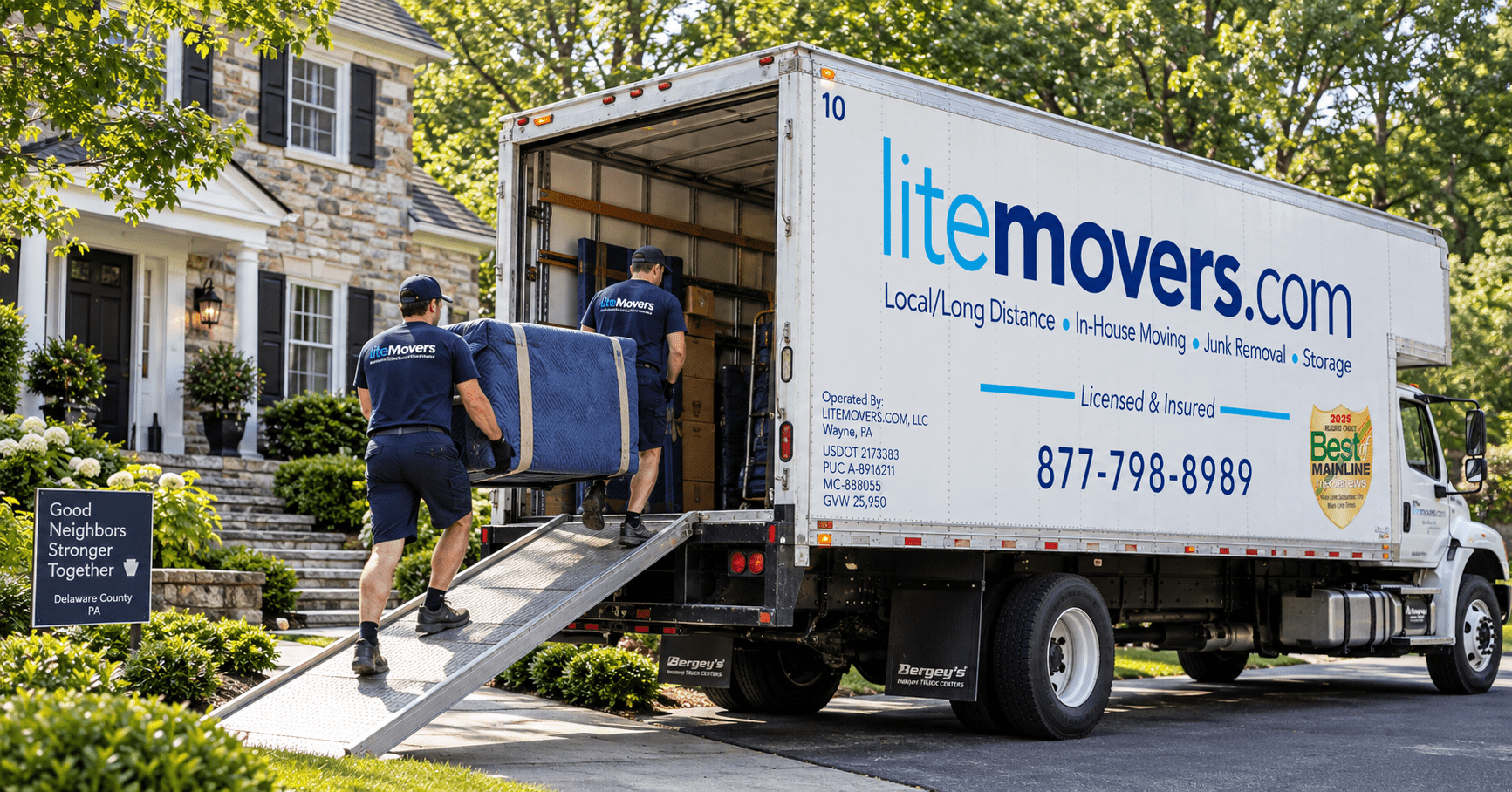
This is the part most supply lists get wrong. They tell you to buy furniture blankets and dollies. You do not need to. A full-service mover brings all protective equipment as part of the job.
On every LiteMovers job, the crew arrives with:
- ✓Quilted furniture blankets — dozens per truck, reused not sold
- ✓Shrink wrap for upholstered furniture and drawer fronts
- ✓Mattress and box spring covers
- ✓Four-wheel dollies, hand trucks, and appliance dollies
- ✓Floor runners and door jamb protectors
- ✓Straps and load bars to secure the load in transit
- ✓Basic tools for disassembling and reassembling beds and tables
Wardrobe boxes are the item worth asking about. Many movers, including LiteMovers, bring wardrobe boxes to the job, load your hanging clothes directly, and take the boxes back at the destination. Ask before you buy eight of them.
What you supply is the packing: boxes, paper, tape, and labels for everything that goes inside a box. If you would rather not handle that either, our packing and moving services cover full or partial packing with materials included.
What supplies do people always forget?
These are the items customers call about the night before, in rough order of frequency.
- A second marker. One marker always goes missing under a pile of paper. Buy two.
- Zip-top bags for hardware. Bed bolts and shelf pins disappear otherwise. Bag them, label them, tape them to the piece.
- Mattress covers. A mattress rides against a truck wall. Unprotected, it arrives dirty.
- Trash bags. You will fill more than you expect at both ends of the move.
- Toilet paper and paper towels for the new place. Nobody packs these last, and everyone needs them first.
- An essentials bin. Clear plastic, loaded last, unloaded first: medications, chargers, a change of clothes, coffee setup.
- Tape for the last five boxes. Always buy one extra roll.
Where can I get free moving boxes?
Free boxes are fine for non-fragile items if you are selective. Mixing sizes makes a truck harder to stack, so use free boxes for the middle of your load and bought boxes for anything breakable.
| Source | Quality | Worth it? |
|---|---|---|
| Liquor stores | Excellent — thick, divided, small | Yes, best free source |
| Grocery produce section | Good — sturdy, but often open-top | Yes, ask early morning |
| Bookstores | Good — small and strong | Yes |
| Buy Nothing and Facebook groups | Mixed — inspect before hauling | Sometimes |
| Office paper boxes | Very good — uniform with lids | Yes |
| Restaurant food boxes | Poor — grease and odor | No |
| Banana boxes | Poor — open handles, no lid | No |
Never use a box that has been stored in a damp basement or garage. Cardboard absorbs moisture and loses most of its crush strength, and it can carry mold into your new home. If it feels soft at the corners, recycle it.
What should you not buy?
A short list of supplies that get pushed hard and rarely earn their place.
- ✓Furniture blankets. Your mover brings them. Buying them is money spent on something already included.
- ✓Printed newspaper. Ink transfers onto dishes and white ceramics. Unprinted packing paper costs a few dollars more and does not.
- ✓Peanuts. Messy, they migrate, and items settle through them in transit. Paper and bubble wrap work better.
- ✓Specialty appliance boxes. A crew wraps and dollies appliances. You do not need a box for a refrigerator.
- ✓More than two extra-large boxes. They get overfilled and become too heavy for their own construction.
How early should you start?
Four to five weeks out, buy supplies. Then pack in this order and the last week stays calm.
| When | What to pack |
|---|---|
| 5 weeks out | Buy supplies. Pack storage areas, attic, basement, garage. |
| 4 weeks out | Books, decor, off-season clothing, guest rooms. |
| 3 weeks out | Art, china, and anything else you rarely touch. |
| 2 weeks out | Most of the kitchen. Keep out one week of dishes. |
| 1 week out | Remaining clothes, linens, everyday kitchen items. |
| 2 days out | Essentials bin. Label it and set it aside from the load. |
For a full week-by-week plan including utility transfers, building reservations, and township requirements, see our moving tips guide.

Frequently asked questions
How many boxes do I need to move a 2-bedroom house?
Most 2-bedroom homes need 45 to 60 boxes. That is roughly 20 small, 20 medium, 10 large, 4 dish packs, and 4 wardrobe boxes. Add 10 more if you have a heavily used kitchen or a home office.
What packing supplies do professional movers bring?
Professional movers bring reusable furniture blankets, shrink wrap, mattress covers, dollies, floor runners, and tools for disassembly. LiteMovers supplies all of these on every move, so you never need to buy them yourself.
Is it cheaper to buy or find free moving boxes?
Free boxes save money but cost time and reliability. Liquor store boxes and grocery produce boxes are sturdy and safe. Avoid banana boxes with open handles and any box that has held food waste or has been damp.
How much packing tape do I need for a move?
Plan on one roll of tape for every 15 to 20 boxes. A 2-bedroom home usually needs 3 to 4 rolls. Buy one extra roll beyond your estimate, because running out mid-pack is the most common supply failure.
What size moving boxes should I use for books?
Always use small boxes, 1.5 cubic feet, for books. A large box filled with books can exceed 100 pounds, which makes it unsafe to lift and likely to burst at the bottom seam.
Do I need special boxes for dishes and glassware?
Yes. Dish packs have double-wall corrugation and cell dividers that keep plates and glasses from touching. Standard boxes lack the crush strength for stacked dishes in a loaded truck.
When should I start buying moving supplies?
Start four to five weeks before moving day. That gives you time to pack a few boxes each evening and to reorder if you underestimated. Waiting until the final week is what causes rushed, poorly packed boxes.
More LiteMovers moving resources
Skip the supply run entirely
LiteMovers packs, supplies, and moves homes across the Main Line, Chester County, Delaware County, Montgomery County, and Philadelphia. Tell us what you have and we will tell you exactly what your move needs.
Call (610) 755-5535Get a free estimate
LiteMovers · 307 East Church Rd, Suites 1 & 2, King of Prussia, PA 19406 · Toll-free 1-877-798-8989
PA PUC A-8916211 · USDOT 2173383 · MC-888055 · Fully licensed and insured

Comments are closed.