


Your OLED television is one of the most technologically sophisticated — and physically fragile — items in your home. Whether you own a 65-inch LG C-series, a Sony Bravia A-series, or a Samsung S90, that panel represents a significant investment. And unlike nearly every other item we move, a damaged OLED panel cannot be repaired.
At LiteMovers, we move fine art, grand pianos, marble sculpture, and antique furniture for families across the Main Line and Chestnut Hill every day. We treat your OLED television the same way: with a purpose-built custom crate, engineered specifically for your panel.
This guide explains exactly what an OLED TV is, why it requires a crate, what our crating process looks like, and what our policy is if you choose not to crate. No surprises on move day.
In this guide: What makes OLED TVs different • How to identify yours • Why blankets and TV kits aren’t enough • What a custom crate looks like • Our policy • What crating costs • Questions to ask when you call
What Makes an OLED TV Different From a Regular Flat Screen?
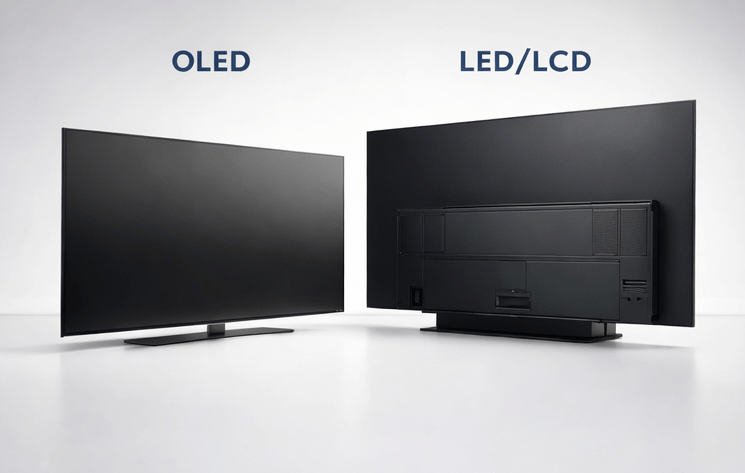
Most flat-screen televisions — including QLED, Neo QLED, and standard 4K LED sets — work by shining a backlight through a liquid crystal panel. That backlight housing gives the TV structural depth and internal rigidity. These televisions are relatively sturdy.
An OLED TV works entirely differently. Each individual pixel generates its own light. There is no backlight. This is what produces the picture quality OLED is known for: perfect blacks, infinite contrast, and colors that simply are not possible on a backlit screen.
But removing the backlight also removes the structural layer that gives a television its rigidity. An OLED panel is, physically, one of the thinnest and most fragile large-format objects you will ever own. There is almost no internal structural support. The panel can flex, fracture, or delaminate from forces that would not affect a standard LED television at all.
How to Tell If Your TV Is an OLED
Not certain? Here are the fastest ways to check:
| What to Check | If It’s OLED | If It’s LED / LCD |
|---|---|---|
| Back of the TV | Perfectly flat and uniform — no raised sections | Has a raised rectangular hump where the backlight lives |
| Panel thickness | Under 1 inch at the edge — remarkably thin | 1.5″–3″+ throughout the body |
| Label or bezel text | Says “OLED” clearly on the bezel or original box | Says QLED, Neo QLED, UHD, or LED |
| Power-on screen | “OLED” flashes briefly when the TV turns on | No OLED indicator on startup |
| What you paid (55″–65″) | Typically $1,100–$3,500+ | Typically $300–$1,500 |
| Brand and model clues | LG C/G/B-series, Sony Bravia A-series, Samsung S90/S95, Panasonic Z-series | Samsung Q-series, Hisense ULED, Sony X-series, TCL, Vizio |
If you’re still unsure, just describe your TV to us when you call — brand, model, approximate age, and what you paid. We can usually confirm it from that information.
Why OLED Panels Are Uniquely Vulnerable During a Move
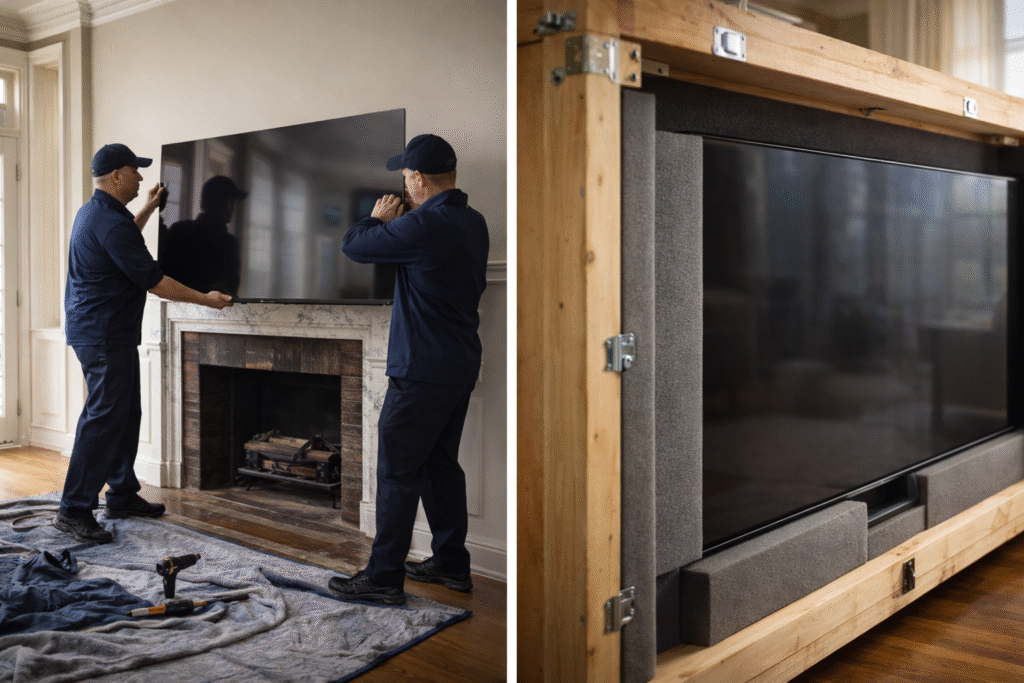
A standard LED/LCD TV can absorb modest vibration and minor handling because the backlight housing acts as an internal spine. An OLED panel has no equivalent. The moving environment — vibration on the truck, acceleration, cornering, loading ramps — introduces forces the panel was never engineered to handle without proper containment.
The specific risks for an OLED during transport include:
- Pressure on the screen face. Even moderate, uneven pressure — from an improperly positioned foam insert, a hand in the wrong place, or a box corner during loading — can fracture the organic layer internally. The crack may not be visible until the TV is powered on.
- Panel flex. A large OLED (65″–77″+) that bends even slightly during lifting or loading can develop stress fractures across the entire display.
- Road vibration over distance. Vibration transfers through the truck floor. Without an isolated, foam-lined crate, that vibration accumulates across the panel during transport.
- Improper orientation. An OLED must travel upright at all times. Laying it flat — even briefly during loading — allows gravity to stress the panel in ways it was not designed to handle.
The cost of a damaged OLED panel
An OLED panel cannot be repaired. Unlike a cracked phone screen, there is no fix. The panel must be replaced — and replacement panels typically cost 60–90% of the original TV’s purchase price, often more than buying a new television outright.
Standard moving company liability is based on weight at $0.60 per pound, not replacement value. A 50 lb. OLED would be covered for $30. A crate costs $200–$425 for the same TV. The math is straightforward.
Our Policy: Every OLED Gets a Crate
LiteMovers will move your OLED television in one of two ways:
- In its original manufacturer’s packaging, if you have retained it and it is undamaged.
- In a custom-built wood crate, fabricated to your television’s exact dimensions.
We do not move OLED televisions using TV box kits, moving blankets alone, or any other method. If you decline crating and do not have the original box, we will exclude the television from the move agreement and assume no liability for it.
This is not a revenue policy. It is a quality policy. We have seen too many irreplaceable OLED panels damaged by well-intentioned but inadequate packing. We will not put our name on a move that ends with a $3,000 television displaying a fractured screen.
This policy reflects the same standard we apply to everything we handle that cannot be replaced at a hardware store: fine art, antique furniture, marble, and heirloom pieces. Some things simply require the right container.
What a Custom TV Crate Looks Like
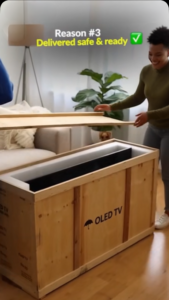
The foam interior contacts the TV frame only — the screen face is never touched. The panel travels in a protected void, isolated from vibration.
Many clients picture a crate as rough lumber nailed around a box. A properly built TV crate is the opposite: it is precision-engineered packaging that happens to be constructed from wood.
Custom television crates are fabricated to the exact dimensions of your specific TV model. The construction uses 3/4-inch plywood with wood-frame reinforcement. The interior is the critical part:
- High-density foam inserts are cut to a glove-fit precision around the TV’s frame.
- The foam contacts the TV at the frame edges only — the screen face is never touched by any material.
- The panel floats in a protected void, isolated from vibration by the surrounding foam.
- The TV travels vertically — upright — inside the crate at all times. Never on its back.
- Heavy-duty latch hardware secures the crate. No tools are required to open it at the destination.
- Large crates may include heavy-duty casters so the TV rolls in and out rather than being lifted.
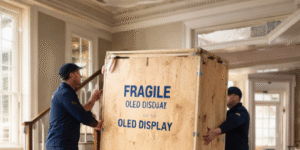
Closed and latched, ready for transport. The crate travels upright, strapped to the truck wall, loaded last and unloaded first.
What About the Original Manufacturer’s Box?
If you kept the original box your OLED came in, that packaging is the gold standard. The manufacturer’s molded foam was engineered specifically for your exact panel. Nothing we can custom-build matches it for precision of fit.
We strongly encourage all OLED owners to retain the original box. Before your move date, check the garage, basement, or storage. It is worth the effort — the original box eliminates the crating charge entirely and represents the highest possible protection for your panel. If you have it, let us know when you schedule your estimate.
If you have the original box
Tell your LiteMovers estimator when you schedule. We will inspect the box for damage and confirm it is appropriate for transport. We will still take the same care loading, positioning, and securing the TV in the truck — upright, strapped, first on and last off. Original box plus LiteMovers handling equals the highest possible protection for your panel.
The Crating Process: What to Expect
Here is exactly how we handle your OLED from the moment we arrive to the moment we leave your new home:
Step 1 — Identifying your TV during the estimate. When you schedule your move, your LiteMovers estimator will ask about your television. We’ll note the brand, model, and screen size. If you know you have an OLED, tell us. We will confirm it during the estimate walk-through if there’s any doubt.
Step 2 — Crate fabrication. We work with a specialized custom crating partner to fabricate your TV’s crate to the exact panel dimensions with a foam interior fitted to your specific model. Lead time is typically 2–5 business days, so please plan accordingly if your move date is close.
Step 3 — Day-of handling.
- We photograph all cable connections and the back of the TV before anything is disconnected.
- All cables, remotes, wall-mount hardware, and stand legs are bagged, labeled, and packed separately.
- The screen is cleaned gently with a microfiber cloth before any wrapping occurs.
- Two crew members place the panel in the crate vertically. It is never set down horizontally, even briefly.
- The crate is sealed, latched, and labeled before it leaves the room.
- In the truck, the crate travels upright, strapped to the truck wall, loaded last and unloaded first.
Step 4 — At your destination.
- The crate is brought into your new home before it is opened.
- We allow the TV to acclimate briefly to room temperature before powering on.
- We reconnect all cables using the reference photos taken at origin.
- We power the TV on and confirm the picture before the crew leaves.
What Crating Costs
Custom TV crating is a separate line item on your move estimate. Cost depends on screen size and whether a new crate needs to be fabricated or we can work from a prior build.
| TV Screen Size | Typical Crating Investment |
|---|---|
| 42″–55″ OLED | $150 – $250 |
| 65″ OLED | $200 – $325 |
| 77″ OLED | $275 – $425 |
| 83″–97″ OLED | $350 – $600+ |
| Original box available (any size) | No crating charge — handling fee only |
To frame that in context: a 65-inch LG or Sony OLED costs $1,400–$2,500 new. A replacement panel, if one can even be sourced, runs 60–90% of that. A crate for the same TV costs $200–$325. The math is straightforward.
The crate can be kept and reused.
A well-built custom crate lasts for multiple moves. If you retain yours, we can use it again for your next move at no fabrication cost — only a handling fee. For clients who relocate regularly or own multiple OLED panels, a reusable crate is an investment that pays for itself quickly.
If You Choose Not to Crate Your OLED
Our position, stated plainly:
If you decline crating and do not have the original manufacturer’s box in good condition, we will remove the OLED television from the move agreement. We will not move it using blankets, TV kits, or improvised protection, and we will not accept any liability for a TV moved by any other method.
You are welcome to arrange separate transport — in your personal vehicle or through a specialized electronics shipper. We are happy to advise on options. We make this policy clear at the estimate stage, not on moving day.
We understand this may feel inconvenient. We also know that discovering a $2,500 television has a fractured panel upon unpacking is far more inconvenient — and that in most cases, nobody is happy with that outcome. This policy protects you as much as it protects us.
Questions to Have Ready When You Call
To give you the most accurate estimate and ensure your crate is ready on move day, it helps to have this information available when you schedule:
- Is your TV an OLED? Brand and model number if you have it.
- What is the screen size?
- Do you have the original box and foam inserts?
- Is the TV currently wall-mounted?
- How many televisions are being moved in total?
- Is this a local or long-distance move?
If you’re not sure whether your TV is an OLED, just describe it to us — brand, model, approximate age, and what you paid. We can usually confirm it from that information alone.
Ready to Schedule Your Estimate?

Schedule your free in-home estimate
Call : 610-755-5535
LiteMovers serves the Main Line (Ardmore, Bryn Mawr, Wayne, Radnor, Villanova), Chestnut Hill, and all of Greater Philadelphia. Estimates are always free and we come to you.
LiteMovers — white-glove moving for Greater Philadelphia’s Main Line and Chestnut Hill. Ardmore • Bryn Mawr • Wayne • Radnor • Villanova • Chestnut Hill • Philadelphia.