

A glass-top coffee table looks simple. It is a piece of glass sitting on a base. Move them separately, wrap the glass in a blanket, stand it in the truck — that is how most moving companies approach it, and it is how most glass-top coffee tables arrive at their destinations chipped, scratched, or in pieces.
A Venetian mirror looks like a mirror. It is not a mirror. It is a composition of hand-cut etched glass plates, silvered glass panels, and decorative glass elements assembled without a conventional frame to hold them together. Move it the way you move a bathroom mirror and you will move it once.
An unframed glass panel — a custom tabletop, a glass shelf, a decorative leaded panel, a freestanding room divider — has no structural protection of any kind built into its form. It is purely glass, and glass has exactly one failure mode: it breaks.
At LiteMovers, we partner with MSS1.com (Precision Packaging & Crating) to fabricate purpose-built crates for every glass and stone furniture top, every Venetian and decorative frameless mirror, and every piece of unframed glass in a move. We carry no coverage for any of these items moved by any other method. This guide explains why — for each item type — and what the crating process looks like.
In this guide: Why glass and stone tops fail in transit • Stone and marble furniture tops • Glass furniture tops • Venetian and decorative frameless mirrors • Unframed glass panels and custom tabletops • What MSS1 builds • Our no-crate, no-coverage policy • Pricing and scheduling
Why Glass and Stone Tops Fail in Transit When Wrapped Without a Crate
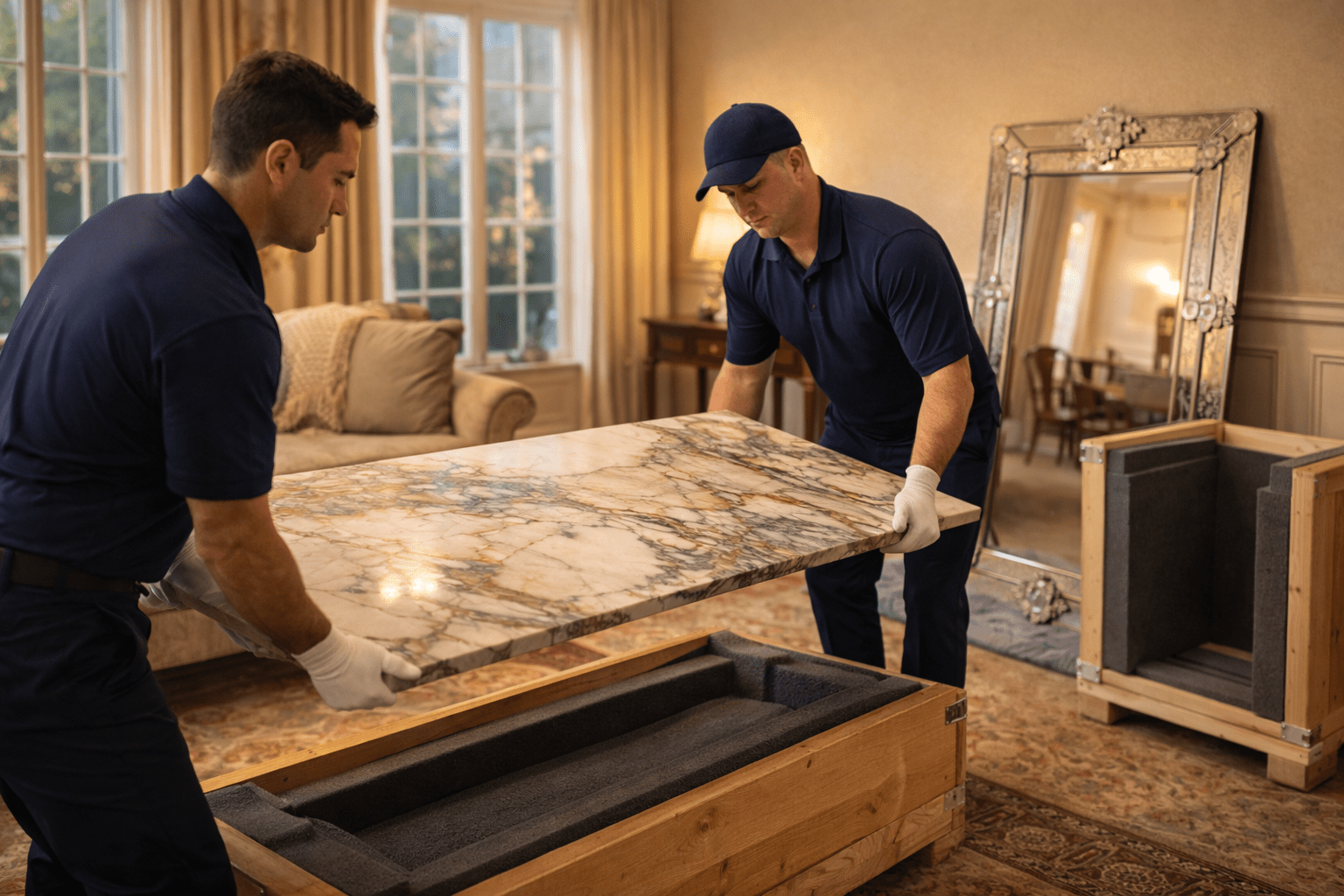
Glass and stone share a structural property that defines how they must be protected in transit: both materials are strong under compression and completely intolerant of flex, point impact, and edge loading. A piece of tempered glass or a marble table top that is fully supported and stationary is nearly impossible to break in normal use. That same piece, unsupported across its span on a moving truck, becomes a liability the moment the vehicle moves.
The three principal failure modes for glass and stone tops during transport:
- Mid-span flex fracture. Any glass or stone top over approximately 24 inches in its shorter dimension will flex under its own weight across an unsupported span. Glass does not flex — it fractures at the point of maximum flex stress. Stone does not flex — it cracks. Both failures produce a clean break across the width of the piece, typically running from one unsupported edge to the other. This happens in the truck, out of sight, often before the vehicle has left the driveway.
- Edge and corner impact. The edges and corners of glass and stone tops are the thinnest, most structurally vulnerable points on any flat piece of either material. A single contact with a hard surface — a loading ramp, another piece of furniture, a truck wall — will chip, crack, or completely fracture a glass or stone edge. Polished and beveled edges are particularly vulnerable because the bevel reduces material thickness at the very point that needs to resist impact.
- Surface abrasion under vibration. Any material in contact with a glass or polished stone surface that moves relative to that surface under truck vibration will scratch it. This includes moving blankets (which contain grit), foam wrap (which can attract fine debris), and other surfaces. Surface scratches on polished glass and honed or polished stone are permanent and require professional resurfacing to address.
Tempered glass does not protect against transport damage
Many glass furniture tops are tempered. Tempering makes glass significantly stronger under impact — it is much harder to break a tempered top with a direct blow than an annealed top. What tempering does not change is the glass’s response to flex stress across an unsupported span or to a concentrated point impact at an edge. Tempered glass that fails from flex or edge impact does not produce a single clean crack — it shatters completely into small fragments, destroying the piece entirely. Tempering raises the failure threshold; it does not remove the failure mode.
Stone and Marble Furniture Tops
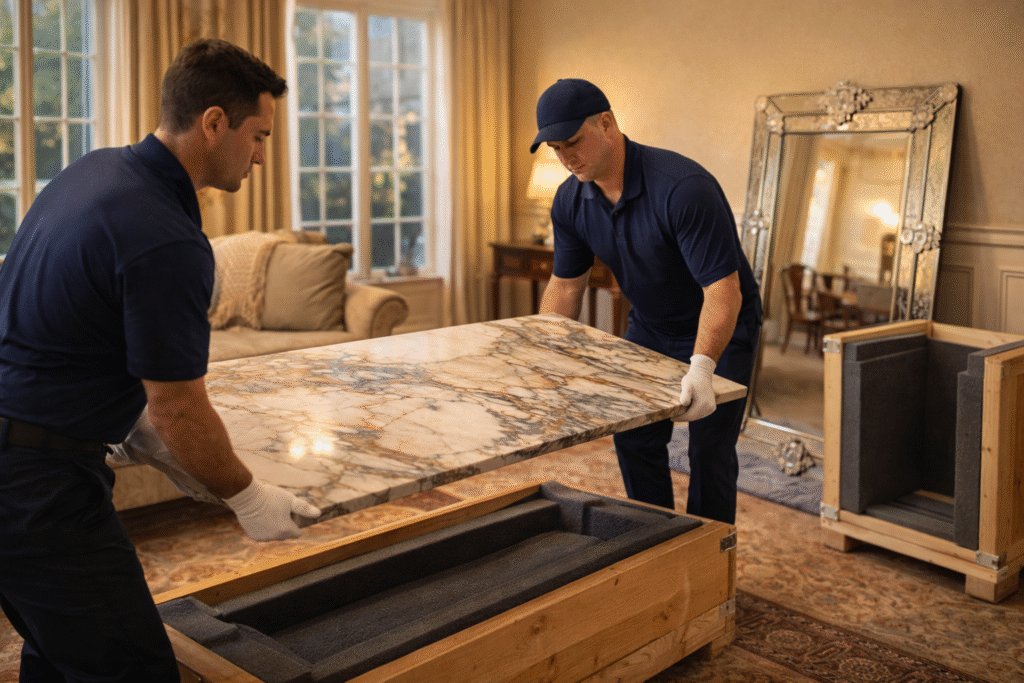
Stone and marble furniture tops — coffee tables, console tables, dining tables, nightstands, side tables, credenza tops — are among the most commonly damaged items in moves where standard furniture handling is applied. They look like part of the furniture. They are not. A marble coffee table top is a stone slab. It has all the transport vulnerabilities of any stone slab and none of the structural support it has when it is sitting on its base.
The specific issues for stone furniture tops:
- The top must be separated from the base. Moving a stone-top table as a single assembled unit — top sitting on base, wrapped in blankets — subjects the top to all the rocking, impact, and flex stresses of the move without any support across its underside. The base is a furniture piece; the top is a stone panel. They need different treatment and they move separately.
- Bookmatched and figured tops are irreplaceable. A bookmatched marble coffee table top — where two slabs cut from the same block are mirror-oriented to create a symmetrical pattern — cannot be duplicated. If one half is damaged, the table is effectively destroyed as a composition, even if the damaged half can technically be replaced with a similar stone.
- Profiled and beveled edges concentrate stress. Stone furniture tops are often given decorative edge treatments: ogee, bullnose, waterfall, or beveled profiles. These profiles remove material from the edge, creating thinner cross-sections that are more vulnerable to chip and fracture under impact than a square edge would be.
- Honed and leathered finishes scratch at lower force thresholds than polished. A polished stone surface shows scratches clearly but requires more force to scratch than a matte honed or leathered surface. Honed and leathered finishes — very popular on Main Line kitchen and living room furniture currently — are softer under abrasion and show contact marks more easily.
How MSS1 crates stone furniture tops
Stone furniture tops travel on edge in their crates — the same principle as countertop slabs. The crate is fabricated to the exact dimensions of the top, with closed-cell foam padding across both faces and reinforced base support rated to the full weight of the stone. For tops with complex edge profiles, the foam is chamfered to maintain standoff distance from the profile without applying pressure. For bookmatched two-piece tops, both halves are crated together in an A-frame crate to preserve orientation.
Glass Furniture Tops
Glass furniture tops range from simple clear tempered glass cut to a rectangle to elaborate custom shapes — organic forms, beveled and polished edges, etched surfaces, tinted and textured glass, multi-layer laminated glass, and thick cast glass tops that weigh as much as a stone equivalent. Each type has specific vulnerabilities that determine the crate design.
Clear and tinted tempered glass tops
Standard clear or tinted tempered glass furniture tops are the most common type and the most commonly handled incorrectly. The assumption that tempered glass is “tough” leads to moving companies attempting to move these pieces wrapped in blankets leaned against truck walls. The results are predictable: edge chips from contact, surface scratches from blanket grit, and occasional complete shattering when the tempered failure threshold is reached from a concentrated edge impact.
Beveled and polished edge glass tops
Beveled glass tops — where the perimeter has been ground and polished to a flat angled facet — are significantly more vulnerable at the edge than a clean square-cut top. The bevel reduces the edge to a thin line rather than a flat face, concentrating any impact force onto a very small surface area. A bevel that contacts a hard surface even at low force will chip. Beveled edges cannot be repaired invisibly; a chip in a bevel typically requires regrinding the entire perimeter, which alters the piece’s dimensions and may not be achievable on irregularly shaped tops.
Etched, patterned, and artistic glass tops
Glass tops with surface etching, sandblasting, or decorative patterning are unique pieces. The pattern is created by removing material from the glass surface, which means the textured areas are thinner than the background glass and more susceptible to fracture initiation from impact. If an etched top breaks, the pattern is lost entirely.
Thick cast glass and specialty glass tops
Cast glass tops — thick poured glass panels in blue, green, amber, or custom colors, often used on statement coffee tables and consoles — combine significant weight (a 1.5-inch thick cast glass top can weigh 80–150 lbs) with the brittleness of all glass under concentrated impact and flex. Their weight makes them difficult to handle safely without immobilization and makes them more dangerous if they shift during transport.
How MSS1 crates glass furniture tops
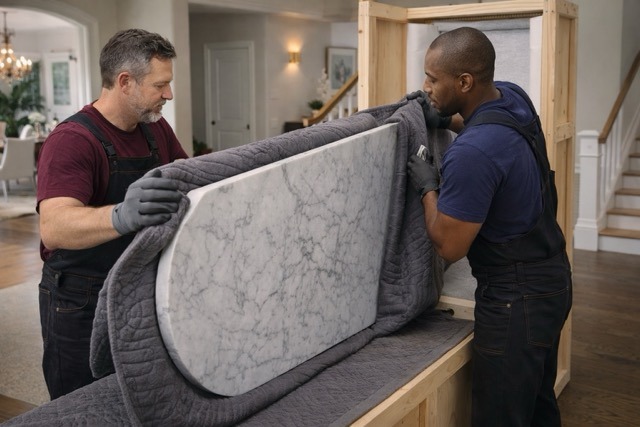
Glass tops travel on edge in their crates — never flat. A glass top lying flat in a truck is a flex fracture waiting to happen. Standing on edge, with the full face supported by foam on both sides, the glass is in its strongest orientation for transport. Crate dimensions are fabricated to the exact size of the top. Edge clearance is maintained at all four perimeter edges so no glass edge contacts the crate wall. For beveled tops, the foam is cut to provide a recessed channel along the edge so the bevel hangs free of all contact.
Venetian Mirrors and Decorative Frameless Mirrors
MSS1.com fabricates all glass and stone crates for LiteMovers to the exact dimensions of each piece. The standard construction for a glass or stone furniture top crate includes:
- 3/4-inch plywood exterior panels with dimensional lumber framing at corners and mid-span. For pieces over 60 inches, mid-span cross-members are added to prevent any flex in the crate walls under the weight of the glass or stone.
- 2-inch closed-cell polyethylene foam face panels (Ethafoam or equivalent) lining both inner faces of the crate. Closed-cell foam maintains its compression resistance throughout the move and does not transmit surface pressure unevenly. The foam is faced with a smooth non-abrasive surface layer on the side that contacts the glass or stone.
- Routed edge channels at the base and sides of the crate interior, providing clearance between the glass or stone edge and the crate wall. No edge of the piece contacts any rigid surface at any point in the crate.
- Reinforced base rated to full piece weight without flex. For very heavy stone tops (over 150 lbs), the base is constructed with doubled plywood and internal blocking.
- Heavy-duty latch hardware on all closures. No fasteners required for opening at destination, allowing inspection without tools.
Lead time for MSS1 glass and stone furniture top crates is typically 2–5 business days. Please account for this when planning your move timeline. We coordinate with MSS1 directly once your estimate is confirmed.
Our Policy: No Crate, No Coverage
LiteMovers policy on glass and stone furniture tops, Venetian mirrors, and unframed glass:
We move glass and stone furniture tops, Venetian and decorative frameless mirrors, and unframed glass panels of any kind only in purpose-built custom crates fabricated to the dimensions of each piece.
We do not move these items using moving blankets, cardboard, foam wrap without a rigid crate, or any improvised method. We do not move glass furniture tops as part of an assembled table wrapped in blankets.
If crating is declined for any item in this category, that item is removed from the move agreement. We carry zero liability for any glass or stone top, Venetian mirror, or unframed glass piece moved without a purpose-built MSS1 crate. This policy applies regardless of the size, shape, or perceived robustness of the piece, and it has no exceptions.
The most common conversation we have — and why we do not change our answer
“It is just a glass table top, can’t you just wrap it carefully?” We hear this regularly. Our answer is always no, and here is why: the word “carefully” does not protect a piece of glass from mid-span flex stress when the truck goes over a pothole. A blanket does not provide structural support. The only thing that prevents the forces that destroy glass tops in transit is a rigid crate that holds the glass on edge with full face support and edge clearance. Careful does not substitute for engineered.
Typical Crating Costs
MSS1 crate pricing is based on piece dimensions, weight, and complexity. The following ranges reflect typical glass and stone furniture top pieces we move in Main Line homes:
| Item Type / Size | Typical Crating Investment |
|---|---|
| Glass or stone side table / nightstand top (under 24″) | $125 – $200 |
| Glass or stone coffee table top (24″–48″) | $175 – $300 |
| Glass or stone console / dining table top (48″–72″) | $250 – $425 |
| Large glass or stone dining table top (over 72″) | $375 – $600 |
| Venetian mirror (any size) | $275 – $550 |
| Large decorative frameless mirror (over 36″) | $200 – $375 |
| Custom-cut or specialty glass panel | $175 – $350 |
| Leaded or stained glass panel | $200 – $450 |
| Cast glass top or specialty thick glass | $275 – $500 |
Crates are reusable.
An MSS1 crate built for your glass coffee table top will outlast multiple moves. Clients who are renovating and need to store glass tops during construction find the crate invaluable — the piece is protected throughout the storage period and ready to move when the renovation is complete. We can store crated glass and stone tops in our facility and deliver on your schedule. Learn more about our storage solutions.
What to Have Ready When You Schedule Your Estimate
When you contact us to schedule your estimate, mention that you have glass or stone furniture tops, mirrors, or unframed glass pieces. Our estimator will walk every room with you, assess each piece, note dimensions and any special considerations, and build the MSS1 crating specifications into your estimate from the start.
Helpful information to have ready:
- A rough count of glass and stone furniture tops in your home
- Any Venetian mirrors, large decorative frameless mirrors, or leaded glass panels
- Approximate dimensions of the largest pieces
- Whether any glass tops are beveled, etched, or have other edge treatments that may affect crate design
- Any pieces you believe may have existing chips or cracks — we document these before crating so condition is clear at delivery
- Whether pieces are going directly to the new home or into storage
Schedule your free in-home estimate
Call or text: 215-555-MOVE
Email: info@litemovers.com
Online: litemovers.com/estimate
LiteMovers serves the Main Line (Ardmore, Bryn Mawr, Wayne, Radnor, Villanova), Chestnut Hill, and all of Greater Philadelphia. Estimates are always free and we come to you.
LiteMovers — white-glove moving for Greater Philadelphia’s Main Line and Chestnut Hill. Ardmore • Bryn Mawr • Wayne • Radnor • Villanova • Chestnut Hill • Philadelphia.