

For collectors, a vinyl record collection isn’t just music — it’s a curated archive of years of hunting, listening, and care. Whether you’ve spent decades tracking down first pressings or you’re three years into a growing wall of LPs, the prospect of moving every record across town (or across the country) is enough to keep any audiophile up at night. Records are deceptively heavy, surprisingly fragile, and notoriously sensitive to heat, pressure, and humidity. One carelessly stacked box or one hot afternoon in a parked truck can warp a record beyond repair.
At Litemovers, we’ve packed and transported countless vinyl collections — from a few milk crates of essentials to floor-to-ceiling shelves of meticulously alphabetized albums. This guide pulls together what we’ve learned so your collection arrives at your new home in the same condition it left.
Why Vinyl Records Need Special Handling
Vinyl is a peculiar material to move. It’s heavy enough that a “small” box can quickly hit 40 pounds, yet thin and pliable enough to warp under sustained pressure or modest heat. The cardboard jackets are vulnerable to ring-wear, seam splits, and crushed corners — damage that immediately kills a record’s collectible value, even if the disc inside still plays perfectly.
The biggest risks during a move are:
- Heat warp: Records can begin to deform at temperatures as low as 140°F — easily reached inside a closed truck on a sunny day.
- Pressure warp: Stacking records flat or piling other items on a record box for hours creates permanent dish-shaped warps.
- Sleeve damage: Tight squeezes, rough handling, and abrasive packing materials can split seams and crush corners.
- Humidity and condensation: Sudden temperature shifts (truck to climate-controlled house) can cause moisture to condense inside sleeves, leading to mildew on cardboard and labels.
Knowing the failure modes is half the battle. The other half is preparation.
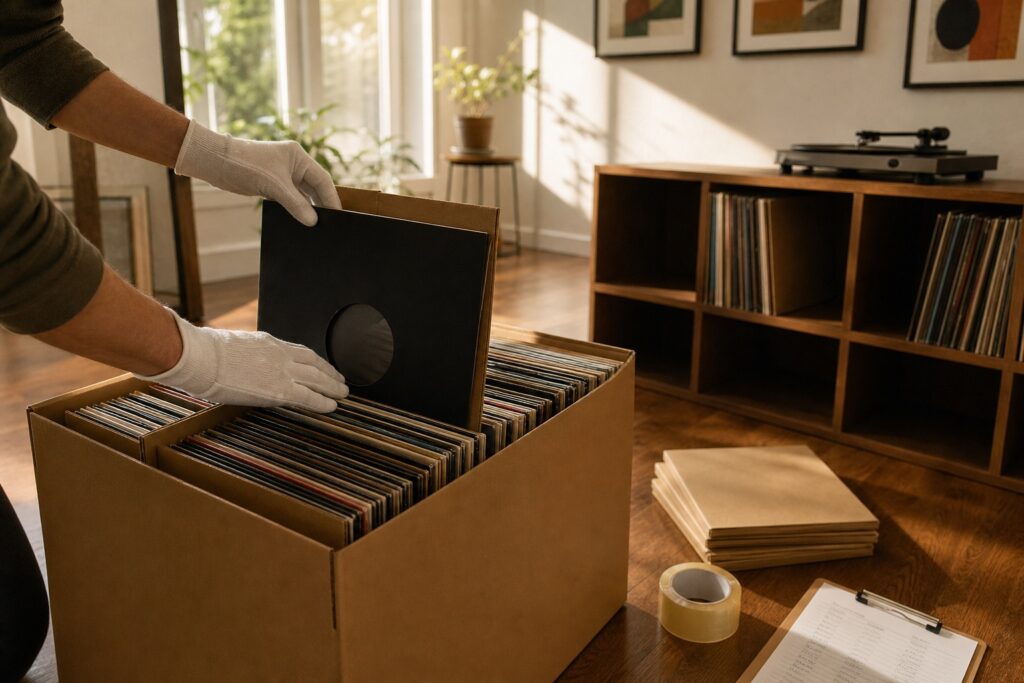
Pack records vertically, with cardboard dividers and snug fillers — never flat, never crowded.
Before the Move: Prep Your Collection
Inventory and Insure
Before a single record goes into a box, take an afternoon to document what you own. A simple spreadsheet — artist, title, pressing, condition, estimated value — protects you in the event of damage and gives you a clean reference for unpacking. Photograph any record that’s worth more than $50 individually, including the label, jacket front and back, and any inserts.
If your collection is worth more than the standard liability coverage your moving company offers (typically $0.60 per pound), ask about declared-value or full-value protection. For high-end collections, a separate scheduled-personal-property rider on your homeowner’s or renter’s policy is often the cheapest route.
Sleeve Check and Light Cleaning
Moving day is a great excuse to do collection maintenance you’ve been putting off. Replace any torn or split inner sleeves with archival anti-static sleeves — paper inner sleeves shed dust and abrasive fibers, which is the last thing you want during a bumpy ride. Give each record a quick visual inspection for warps you might have missed; warped records can transfer pressure to neighbors and should be packed at the ends of the box.
Choosing the Right Packing Materials
What to Use
- Small, sturdy boxes sized to fit records snugly (about 13–14 inches square interior). New, double-walled boxes are worth the cost — secondhand boxes lose their structural integrity.
- Specialty record mailers or LP shipping boxes for high-value pieces, available from any record-supply retailer.
- Acid-free packing paper or bubble wrap to fill voids at the top and ends of each box.
- Cardboard dividers every 25–30 records to absorb pressure and keep groups upright.
What to Avoid
- Plastic totes — they trap heat and create a humidity microclimate.
- Oversized boxes — packing more than about 60–75 records per box pushes the weight past 50 pounds and invites injuries and dropped boxes.
- Newsprint directly against jackets — fresh newspaper ink can transfer onto white or glossy sleeves.
Step-by-Step Packing Process
Pack records vertically, on their edges, exactly the way they sit on a shelf — never flat. Flat-stacking is the single most common cause of move-related warping, and it gets worse with every record added on top.
- Line the bottom of the box with a layer of crumpled packing paper or a flat sheet of cardboard for cushioning.
- Slide records in vertically, with the open end of the inner sleeve facing up so the record can’t slip out during transit.
- Pack tightly enough that records don’t slide or lean, but not so tight that you have to force them in. If a record fights you on the way in, it’s compressed enough to risk warping.
- Insert a cardboard divider every 25–30 records.
- Top off the box with crumpled paper to lock everything in place, then tape the box closed along every seam.
- Label clearly: “VINYL — KEEP UPRIGHT — DO NOT STACK.”
For mailers and shipping boxes used on rare records, follow the manufacturer’s recommended packing pattern — typically the record goes between two stiffeners, then into the inner sleeve and outer mailer, with the LP centered.
Loading and Transporting Records
Truck Placement
Vinyl boxes belong in the cool, central part of the truck — never against an exterior wall that bakes in the sun, never near the cab over the engine, and never in the wheel-well area where vibration is worst. Load them upright and never stack anything heavier than another record box on top. A single full box of records on top of a half-empty record box for an eight-hour drive is enough to dish the records below.
Climate Considerations
If your move falls in the heat of summer or you’re driving through warm regions, plan around the temperatures. A truck parked overnight in a Phoenix summer can hit 150°F internally — well past the warp threshold. For long-distance moves with valuable collections, climate-controlled transport is worth asking about. The Library of Congress’s preservation guide for sound recordings recommends storing records between 65°F and 70°F at 45–50% relative humidity — a useful target for transport too, when feasible.
Special Considerations for Rare and Signed Records
If you own first pressings, signed jackets, test pressings, or anything irreplaceable, treat them like jewelry, not furniture. Pull them from the main collection and pack them separately into a single labeled box that travels with you in your car, not in the moving truck. Use archival outer sleeves to protect jackets from rubbing, and document each record’s condition before and after the move with photos.
For a particularly valuable collection, ask your mover whether they’ve handled vinyl before and what their policy is on declared-value coverage for collectibles. A specialty mover who’s done it many times will have specific answers — generic answers are a red flag.
Setting Up Your New Listening Space
Unpack in the Right Order
Resist the urge to unbox records on day one. Set up your turntable, receiver, and shelving first so records can go directly from box to shelf, vertical the entire time. Records left flat-stacked on a floor “for a few days” while you finish unpacking is the second most common warp scenario we see.
Climate in Your New Home
Position your shelves away from sunny windows, exterior walls in extreme climates, and heat sources like radiators or HVAC vents. If you’re moving to a notably more humid or drier region than you came from, give your collection a few weeks of acclimation in conditioned space before sealing records back into tight outer sleeves.
When to Call Specialty Movers
For collections under a few hundred records, careful self-packing and a standard mover are usually fine. Above that — or anytime your collection contains pieces you’d be heartbroken to lose — it’s worth bringing in movers who treat vinyl as the fragile collectibles they are. At Litemovers, that means proper boxes, climate-aware loading, padded transport, and a crew that understands why “keep upright” is non-negotiable.
Ready to Move Your Collection?
Your records spent years finding you. They deserve a move that treats them accordingly. Contact Litemovers today for a free, no-obligation quote on your specialty move — we’ll walk you through exactly how we’d handle your collection and answer any questions about packing, transport, or insurance. Reach us at litemovers.com/contact or call our specialty-moves team directly.
© 2026 Litemovers. All rights reserved.