

Will My Furniture Fit in a Senior Living Apartment?
Some of it will, and most of it won’t — not because the rooms are small, but because there are fewer of them. Measure every large piece, plot it on the community’s floor plan at the same scale, then check doorway, elevator, and hallway clearances before you decide what stays.
Families in Gladwyne, Bryn Mawr, Newtown Square, and Abington hear that from us weekly. The mistake is rarely a tape measure error — it is assuming a house’s worth of furniture sorts into a smaller version of the same rooms.
Not sure what will make it through the door? LiteMovers will measure the pieces you are unsure about and put it in writing. Call (610) 755-5535 or toll-free 1-877-798-8989 to request a written estimate.
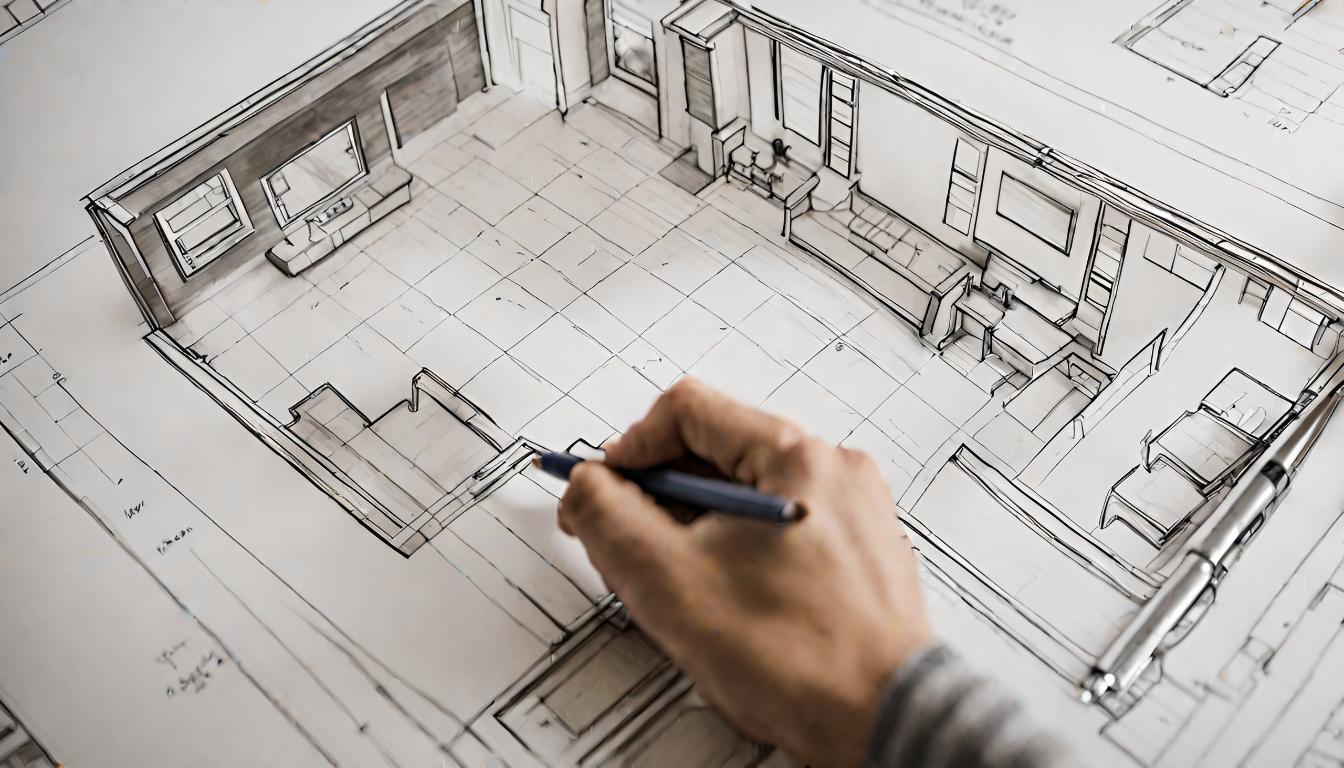
A scaled floor plan is the fastest way to find out what fits.
Why doesn’t furniture that fits a house fit a senior apartment?
A four-bedroom colonial in Berwyn and a two-bedroom independent living apartment can have surprisingly similar room dimensions. What changes is the count. The house had a living room, a family room, a den, and a finished basement, and each absorbed a sofa, a bookcase, or a cabinet. The apartment has one main living space doing all of that work at once.
The real constraint is not square footage. It is uninterrupted wall length. Apartments built for older adults are generous with windows, closets, and doorways — good for daylight and access, terrible for a nine-foot wall unit. When we survey a home for a senior move, we tally usable wall runs on the new plan first, then work backward to the furniture.
Circulation is the second constraint, and the one people underestimate. A path that felt fine carrying laundry needs to stay clear for a walker or wheelchair. Furniture that technically fits can still make a room fail.
How do you measure furniture the right way?
Measure at the widest point, not the pretty point. Five numbers per piece, in this order:
- Width at the widest point, including arms, feet that splay outward, and any trim.
- Depth front to back, with recliners and lift chairs measured fully reclined as well as upright.
- Height to the tallest point — finials, armoire crowns, and headboard posts all count.
- Diagonal depth, corner to corner through the body of the piece. This is the number that decides whether a sofa turns a corner.
- Disassembled dimensions, if the piece comes apart. A bed frame or a table with removable legs may pass as components when it would never pass whole.
Write every number on a sticky note taped to the piece itself, so anyone helping — a daughter visiting from out of state, a move manager, our crew — works from the same data.
How do you test furniture against the floor plan?
Two methods work. Low-tech: print the plan, cut paper rectangles to the same scale for each piece, and slide them around — twenty minutes, and remarkably honest. Full-scale: outline the new room’s dimensions in painter’s tape on your current floor and place the actual furniture inside it.
Then check what a paper plan will not tell you: whether the sofa blocks a radiator, whether the dresser covers an outlet, whether the recliner clears the wall behind it. Our post on using space well when you downsize goes deeper on layout.
What about doorways, elevators, and turns in Philadelphia-area communities?
This is where local knowledge earns its keep. Senior communities across Montgomery, Delaware, and Chester Counties were built across a wide span of decades, and access realities vary accordingly.
- Older campuses and converted buildings often have narrower service elevators than passenger elevators, plus a landing turn that caps how long a piece can be.
- Cottage and villa units — common at campuses in Gwynedd, Newtown Square, and West Chester — frequently have an interior stair with a tight quarter-turn at the top.
- Newer apartment buildings usually have a loading dock and padded freight elevator, but the window must be booked in advance, sometimes weeks out.
- Main Line properties on the moving-out side add century-old stairwells with turns that never anticipated a king mattress. Our Main Line residential crews plan around these routinely, including moves into Waverly Heights in Gladwyne.
Ask the community three questions early: the elevator’s interior dimensions, the narrowest doorway on the route, and the hours the loading area is available. Those answers eliminate most moving-day surprises.
Access on both ends decides more than room size does.
Which pieces almost never fit, and which usually do?
The patterns hold up across Chester County senior relocations and their Montgomery and Delaware County equivalents:
Rarely fits
- Full dining sets with leaves and six or more chairs
- Sectional sofas, and any sofa over about seven feet
- China cabinets, breakfronts, and tall wall units
- King beds, in most one-bedroom plans
- Large entertainment centers built for a tube television
Usually fits
- Loveseats, apartment-scale sofas, and a favorite armchair
- Queen and full beds with a low-profile headboard
- Single dressers, nightstands, and a chest of drawers
- Round or drop-leaf tables seating four
- One or two bookcases, ideally shorter than the window sill line
- Desks, secretaries, and small pieces with sentimental weight
What do you do with the furniture that doesn’t fit?
Decide early, because the best outcomes take time. Family need weeks to arrange transport. Consignment shops and auction houses want photos and dimensions first. Donation organizations schedule pickups on their calendar, not yours.
What is left can go out with the move itself. We handle removals and donation runs the same day as the load. If a decision genuinely cannot be made yet — a dining table three siblings are still discussing — short-term storage at our King of Prussia warehouse buys time without derailing the move date.
When should you start measuring?
- Eight to twelve weeks out: request the dimensioned floor plan and measure your must-keep pieces.
- Six to eight weeks out: plot the plan, decide what comes, and start the family conversations.
- Four to six weeks out: book the walkthrough survey, get the written estimate, and reserve the elevator window.
- Two to four weeks out: confirm consignment and donation pickups.
For families coordinating this alongside care planning or in-home support, the Montgomery County Office of Aging Services and the Pennsylvania Department of Aging are good starting points for what sits outside a moving company’s job.
Frequently asked questions
How do I get a dimensioned floor plan for a senior living apartment?
Ask the community’s move-in coordinator for the floor plan PDF for your specific unit, not the model. Most Philadelphia-area communities have one on file. If no dimensions are printed on it, ask staff to measure the walls in your actual unit.
What is the most common furniture mistake people make when downsizing?
Bringing the full dining set. A table with leaves and six or eight chairs eats the open floor a walker needs, and it competes with the only wall long enough for a sideboard. A smaller table with four chairs keeps the room usable.
Can movers tell me in advance whether a piece will fit?
Yes. During a walkthrough survey we measure oversized pieces, check the doorways, turns, and elevator on both ends, and tell you plainly which items are a problem. That happens before your written estimate, so you decide with real numbers.
Should I measure before or after I choose an apartment?
Before, if you can. Knowing your bedroom set needs a certain wall length turns apartment selection into a filter rather than a compromise. If you have already signed, measure right away so you have weeks to rehome what will not fit.
Talk it through with a mover who has seen the building
Will the sofa turn the corner? Will the dresser clear the elevator? Those get answered at the survey, not on moving day. LiteMovers is licensed by the Pennsylvania Public Utility Commission under PA PUC A-8916211, and carries USDOT 2173383 and MC-888055.
Ready to find out exactly what fits? LiteMovers will measure the pieces you are unsure about and put it in writing. Call (610) 755-5535 or toll-free 1-877-798-8989 to request a written estimate.
LiteMovers
307 East Church Rd, Suites 1 & 2, King of Prussia, PA 19406
Phone: (610) 755-5535 | Toll-free: 1-877-798-8989
Email: moves@litemovers.com
PA PUC A-8916211 | USDOT 2173383 | MC-888055

Comments are closed.