

Most sofas fit if the doorway’s clear width is at least equal to the sofa’s diagonal depth measured from the top back corner to the front bottom corner. Measure the sofa’s diagonal depth, the narrowest doorway, and the tightest turn before moving day — that combination decides everything.
The weight and the awkward shape are solvable. Fit is the one variable that can stop a move cold — and in the Greater Philadelphia housing stock, where most doorways were framed before oversized modular seating existed, it stops more moves than you would expect.
Not sure your sofa clears the stairwell? Call (610) 755-5535 and request a written estimate before you commit to moving day.
What measurements do you actually need?
Four numbers, taken with a tape measure and written down. Guessing is where people get into trouble.
- Diagonal depth of the sofa. Run the tape from the highest point of the back frame to the front bottom corner of the base. This is what the sofa travels on when it goes through a door on its side, and it is almost always smaller than the stated depth.
- Clear doorway width. Open the door fully and measure jamb to jamb — not the trim, not the listed door size. A “36-inch” door with stop molding and a swung-back slab often yields 33 or 34 inches of real opening.
- Clear doorway height. Floor to the underside of the jamb head, for anything that has to go through upright.
- The tightest turn. Hallway width and landing depth wherever the sofa must pivot. A straight narrow hall is fine; a narrow hall ending in a 90-degree turn onto a small landing is where sectionals get stuck.
Compare diagonal depth to clear doorway width. Smaller diagonal, and the piece goes through on its side. Within an inch of each other, and it is a maybe — worth flagging before the truck is loaded.
Why do Philadelphia-area homes make this harder?
Because the local housing stock is old, and old houses were framed around furniture that no longer exists. A few patterns come up constantly on our jobs:
Philadelphia rowhomes
The vestibule is the choke point, not the front door: two doors in sequence with three or four feet between them leaves nowhere to rotate a long piece. In Fishtown, Point Breeze and much of South Philadelphia the interior stair is a straight run walled on both sides, so a sofa cannot be angled the way it can on an open staircase. Our Philadelphia moving crews plan the vestibule pivot before anything comes off the truck.
Main Line twins and older colonials
Ardmore, Narberth, Bala Cynwyd and Haverford are full of turn-back staircases — a flight, a small square landing, then a 180-degree turn. That landing is the number that matters, and it is often barely wider than the stair. Original 1920s doorways in these houses frequently measure 30 to 32 inches clear. Anyone quoting a Main Line residential move without walking the stairs is guessing.
Walk-up apartments and mill conversions
Conshohocken and Manayunk have many converted mill buildings where the units are generous but the access is not: exterior stairs, a shared landing, sometimes one freight elevator with a posted reservation window. If you are moving into an apartment in Conshohocken, note that the elevator interior and its door opening are two different measurements.
Newer King of Prussia and Wayne buildings
Elevator buildings are easier, with one catch: the car’s diagonal is the real limit, and padded walls eat two to three inches of it. Where a certificate of insurance and a booked freight window are required, a failed fit costs the reservation too. Our apartment moving team handles that paperwork alongside the logistics.
Can a sectional be taken apart?
Usually. Modular sectionals join at metal or plastic connector brackets underneath the seat deck — lift a section slightly and the pieces slide apart vertically. Chaise sections and armless middles separate most easily. Beyond splitting the modules, there are three more places to find clearance:
- Legs off. Most unscrew or come off with four bolts. Bag the hardware and tape it under the frame.
- Back off. Many sleepers and some sectionals have a rear panel held by clips or bolts, which can drop overall height six inches or more.
- Door off. Pull the hinge pins and unscrew the stop molding on the strike side — together that often adds close to two inches of clear width.
What is not adjustable is a sofa on a single welded or one-piece hardwood frame — many high-end roll arms and older custom pieces. Those move whole, and diagonal depth is the whole ballgame.
How do you protect the sofa and the house?
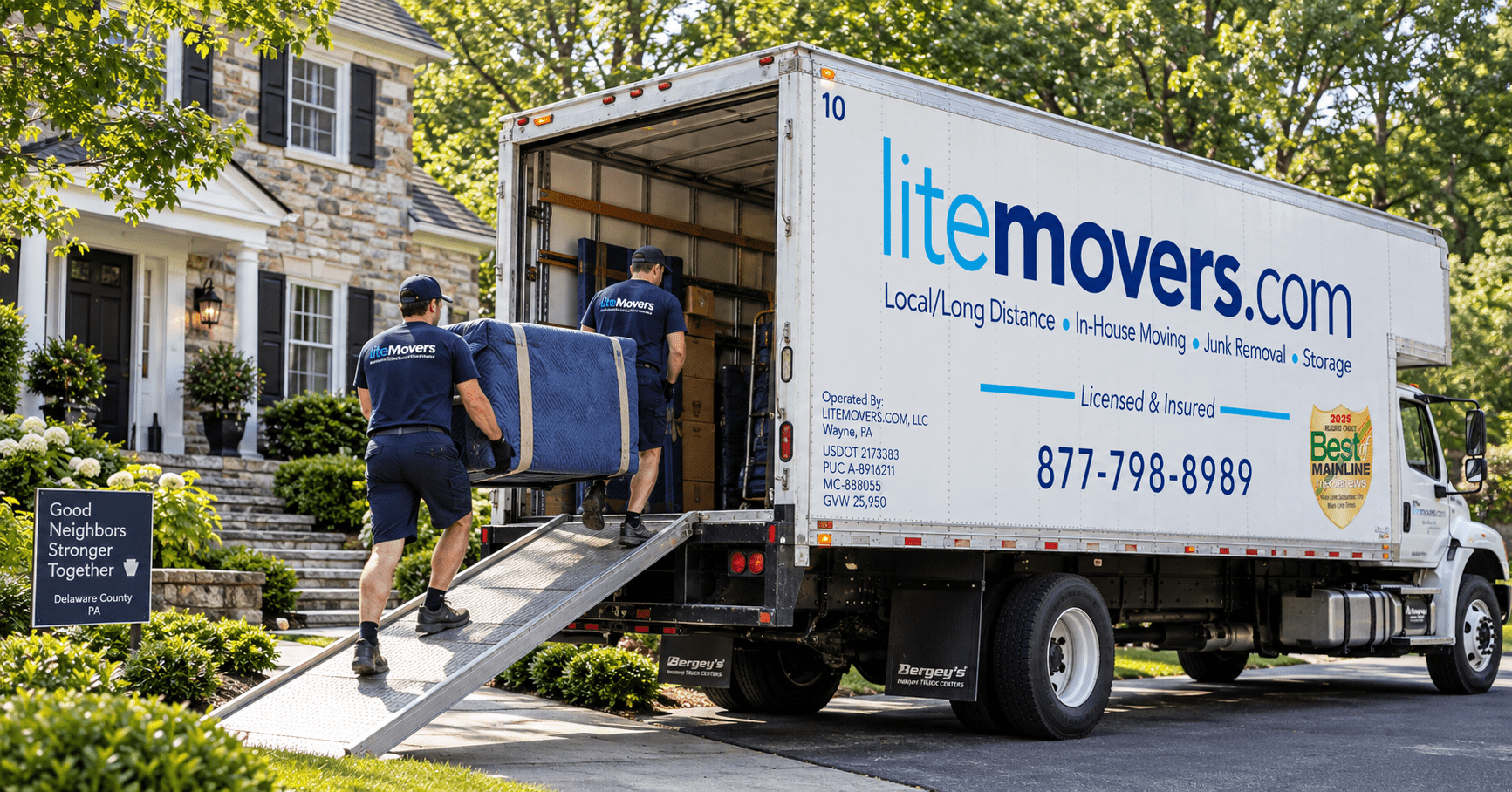
The sofa gets shrink-wrapped over moving pads, with the arms doubled up since they hit first. In the house, jamb protectors go on every doorway along the path, the banister and newel post get padded, and floor runners go down. Hardwood is the most common casualty here, which is why protecting hardwood floors during a furniture move gets its own writeup. If the piece has to wait on a room, our packing and storage services keep it wrapped and off the floor.
What do you do about the street and the parking?
An oversized piece needs room to be set down and rotated outside the door, and on a narrow city block you do not have that room unless you reserve it. In Philadelphia, that means applying for a Temporary No Parking permit at least four business days ahead and posting the signs 24 hours out. Township requirements vary — Lower Merion publishes its permits and forms online, and most neighboring municipalities handle right-of-way requests through public works.
Confirm your mover’s authority too. PA household goods carriers are regulated by the Pennsylvania Public Utility Commission. LiteMovers operates under PA PUC A-8916211, USDOT 2173383 and MC-888055, from 307 East Church Rd, Suites 1 & 2, King of Prussia, PA 19406.
When should you decide the sofa is not coming?
At the estimate, not on the truck ramp. A survey is when you still have options — sell it, donate it, hoist it if the building permits, or store it. Discovering the problem at 8 a.m. with a crew in the driveway turns a furniture decision into a scheduling one. That is why we walk the access and put it in writing. Our estimate FAQs explain what a survey covers, and our local moving services page shows how a Greater Philadelphia move is planned from survey to delivery.
Frequently asked questions
Do movers take sectional sofas apart?
Yes. Most modular sectionals separate into two or three pieces at metal or plastic connector brackets under the seat deck, and a professional crew will split them before attempting a tight doorway. Sofas built on one continuous frame cannot be separated, so those move as a single unit and depend entirely on diagonal depth.
How do you measure a sofa to see if it will fit?
Measure three things: the sofa's diagonal depth from the top back corner to the front bottom corner, the clear width of the narrowest doorway with the door open, and the tightest turn along the path. If diagonal depth is smaller than the clear doorway width, the sofa will usually go through on its side.
Can you remove a door to get a couch through?
Often, yes. Taking a hollow-core interior door off its hinges and unscrewing the strike-side stop molding can add roughly two inches of clear width, which is frequently the difference between a fit and a no-fit. Storm doors and screen doors on Philadelphia-area twins and rowhomes come off quickly too.
What happens if the sofa will not fit at all?
The realistic options are a balcony or window hoist where the building allows it, selling or donating the piece, or storing it until it can go somewhere that fits. LiteMovers flags the problem at the estimate stage so you decide in advance rather than on moving day.
Get the measurements checked before moving day
Send us photos and dimensions and we’ll tell you whether your sectional clears the stairwell — before you’re standing in the doorway with it. Every LiteMovers estimate is put in writing.
(610) 755-5535 • 1-877-798-8989 • moves@litemovers.com
307 East Church Rd, Suites 1 & 2, King of Prussia, PA 19406 | PA PUC A-8916211 | USDOT 2173383 | MC-888055

Comments are closed.